
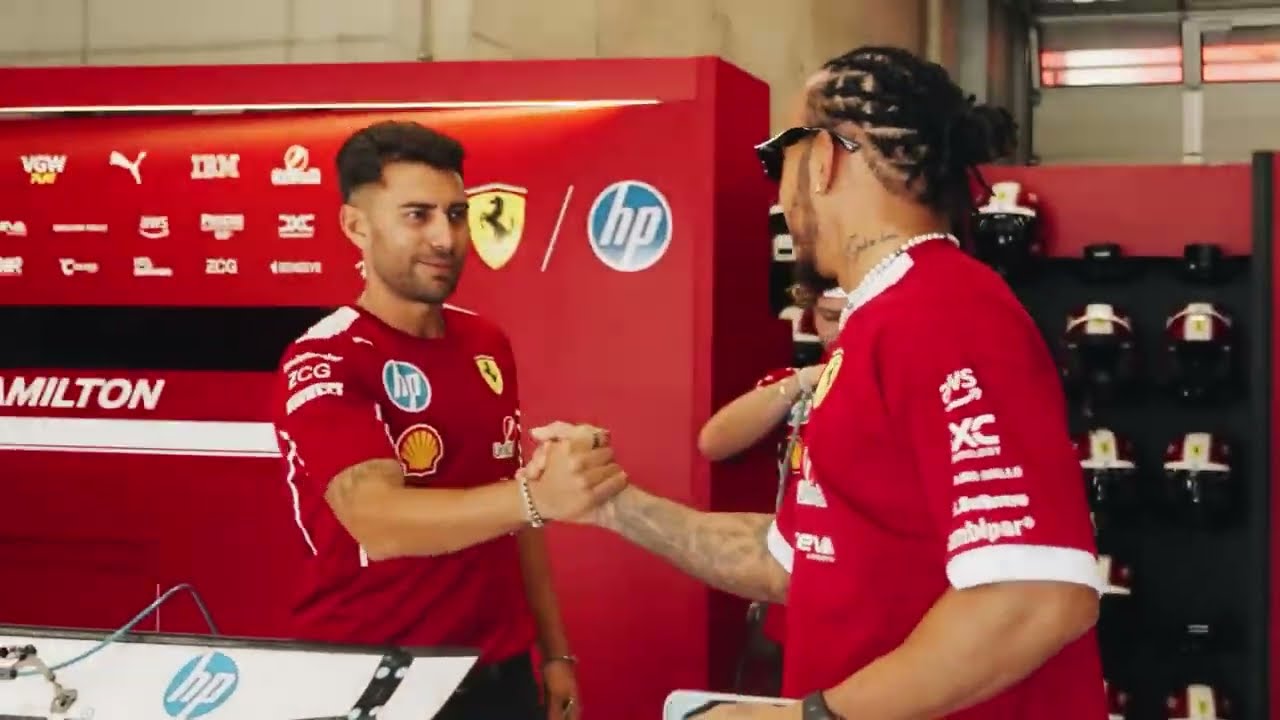
Last weekend’s United States Grand Prix at the iconic Circuit of the Americas was, on paper, a race of records. Lewis Hamilton achieved an incredible milestone, becoming the first Formula 1 driver in history to surpass 5,000 career points. At the same time, he also set a less-enviable record: the longest-ever start for a Ferrari driver, 19 races, without a single podium finish. Elsewhere, McLaren’s Lando Norris celebrated his 15th podium of the season, the most any driver for the legendary team has ever achieved in a single year.
But these statistics, flashing across the screen, masked a dull and worrying reality. Beneath the surface of broken records, the actual racing was, by many accounts, painfully boring.
Fans were treated to a momentary spark of action as Ferrari’s Charles Leclerc put on an impressive defensive driving clinic against the much-faster Lando Norris. But that was the exception. For the vast majority of the race, the top ten cars simply circulated in formation, locked in place, unable to pass. The spectacle was a high-speed procession, not a race.
This isn’t a new phenomenon, but it’s a growing problem that has reached a boiling point. The races, drivers warn, are now being decided in the first few seconds. And after this latest display in Austin, the sport’s biggest stars are getting sick of it. They are furious with the state of Formula 1, and they are pointing the finger at two core issues: the tires and the rules.
The “Race to Turn One” Crisis
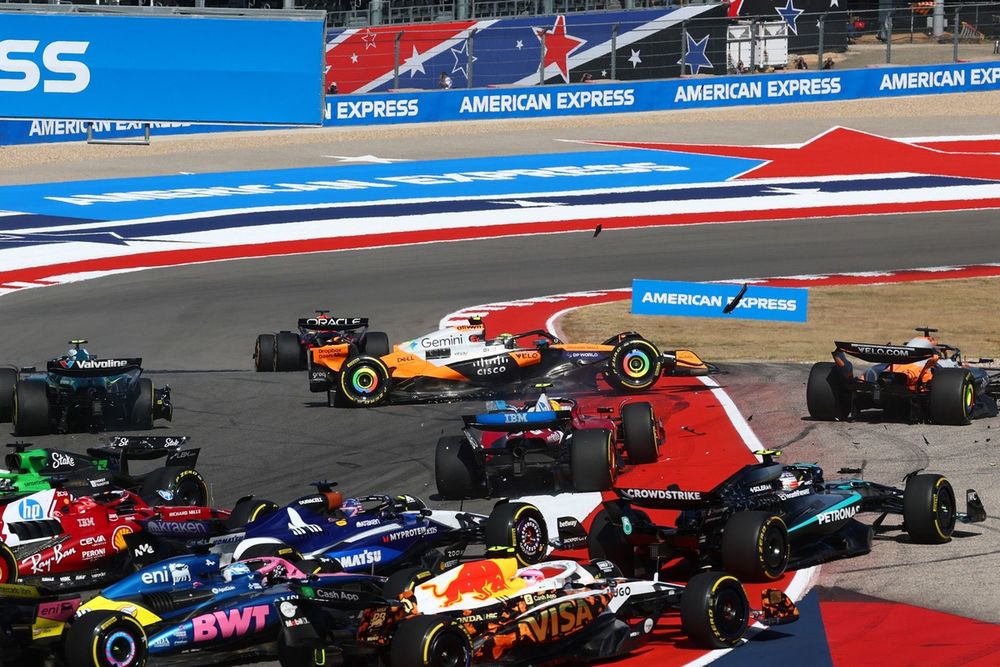
No driver was more visibly and vocally frustrated after the race than Mercedes’ George Russell. His entire race was a perfect, and infuriating, case study of F1’s current malaise. Russell, who finished in sixth place, explained that his fate was sealed the moment the lights went out. He started sixth, and after the initial dash to the first corner, he came out in sixth. He would finish the race in that exact same position.
“Right now in F1, it’s a race to turn one,” Russell bluntly told Sky Sports F1. “If I came out of turn one in P3, I’d have been on the podium today, but instead I came out in P6 and I finished P6.”
His frustration highlights the core issue: overtaking has become nearly impossible. In the current era of F1, the dominant and safest path to victory is the “one-stop” strategy. Because passing another car on track is so extraordinarily difficult, “keeping track position is vital to success,” as the analysis noted.
Why gamble on a “two-stop” strategy? Doing so would mean a driver has to pit for fresh tires, fall behind, and then fight their way back through the field by making numerous overtakes. In today’s F1, that is a “huge gamble which often doesn’t pay off”. It’s far safer to pit only once and simply hold your position.
The root of this “processional” racing, Russell argues, is the tires. The sport’s official tire manufacturer, Pirelli, has been tasked with creating durable, safe tires. The problem, it seems, is that they have done their job too well.
“There’s no tire degradation,” Russell explained. Normally, racing is made exciting by a “tire delta”—a difference in performance as one driver’s tires get old and worn out, while another driver on fresh tires can attack. That performance difference is what creates overtaking opportunities.
But that delta is gone. “Every track we go to, you need at least half a second [per lap advantage] to overtake,” Russell said. With the current tires, that performance gap never opens up. Even though the top four teams are incredibly closely matched—which should create amazing racing—it has the opposite effect. Without any tire degradation, no one can get the critical advantage needed to make a pass. The result? “That’s why you’re not seeing any overtakes,” Russell stated flatly. “I don’t remember the last two-stop race.”
Pirelli’s “Thankless Job” and the Team Dilemma
Russell was quick to point out that Pirelli is in a “thankless job”. F1’s tire supplier is in an impossible, no-win situation.
“Pirelli get a hard time no matter what,” the British driver admitted. “When there’s a lot of tire degradation, people say ‘it’s not real, the drivers can’t push, we have to manage.’ We don’t like that. When there’s no tire degradation, we say ‘it’s a boring race, we want to see [more].’ They don’t seem to be able to win”.
The drivers are clear on what they want. They want a tire they can push “full gas,” but one that doesn’t last the whole race. Russell’s ideal solution? A tire that “falls off a cliff” after a set number of laps. “Ideally,” he mused, “the soft tire does 12 laps, the medium tire does 15 laps, and the hard tire does 20 laps, and then it falls off a cliff”. This would forcibly end the “one-stop” meta, mandate two or even three-stop races, and create the strategy and tire-life variations that lead to exciting, on-track battles.
Pirelli has, in effect, created a “very good” tire that is durable and safe, but as Russell concluded, “it causes bad racing”.
But there is another, more cynical layer to the problem: the teams themselves. While drivers and fans crave excitement, the teams crave control. A “safe” one-stop race, with no tire-life variables, is exactly what they want. It “remove[s] the tires of the variable in performance” and instead allows them to focus purely on their car’s setup and development. The teams, as the video’s narrator explained, “aren’t bothered about how exciting the racing is”. They just want their “fate to be in their own hands”. More stops and more overtaking just add variables they can’t control.
This is where Formula 1’s governing body, the FIA, must step in. The solution, it’s argued, is for F1 to “work with Pirelli to produce a tire that creates great racing”. It won’t be easy, and it will require “the bravery to stand up to the pressure from the teams,” but it’s the only way the racing can be improved.

“The Silliest Rule”: Lando Norris’s Track Limit Fury
As if the tire-induced procession wasn’t bad enough, the drivers are also furious about the rules that govern them. Lando Norris, despite his record-breaking podium, was fuming about F1’s strict “track limits” regulations.
Norris’s frustration boiled over during his battle with Leclerc. On his way to second place, Norris had to overtake the Ferrari twice. But in the process of fighting for position, he used up three of his four allotted “strikes” for exceeding track limits. This meant that for the entire rest of the Grand Prix, he had to drive with extreme caution, carefully avoiding any further breaches, knowing that one more “strike” would result in an automatic, race-ruining five-second time penalty.
He was being punished, he felt, for simply racing.
“One of my strikes was because I was racing,” Norris said, baffled. “I think that’s one of the silliest rules that we have. We’re invited to try and race, but if you race too much, you get a penalty for it”.
Norris’s third strike was collected when he went off the track while “trying to go around the outside” of Leclerc. He argued that this breach should never have been counted against him because he gained no advantage. In fact, he “los[t] time” during the failed attempt. Yet, he was penalized, a move that “doesn’t really make much sense in terms of going racing” and “definitely made my life that little bit trickier”.
While the stewards can disregard a strike if a driver was forced wide, they often don’t. This creates a black-and-white system that penalizes drivers for the very thing fans pay to see: wheel-to-wheel action.
Of course, there is a counter-argument. Consistency is important. As the narrator noted, “if you give the drivers an inch, they will take a mile”. If the FIA goes softer on track limits, drivers will push them constantly. Strict rules, even if harsh, “provide consistency, which is more important” than introducing “gray areas” where stewards have to make subjective judgment calls.
The easy solution would be to line the circuits with gravel or grass, creating a natural penalty for going off-track. But sadly, modern tracks can’t do this, as they have to host “other series outside of F1,” like motorcycle racing, which require tarmac run-offs for safety.
Formula 1 finds itself at a critical juncture. The sport is celebrating record-breaking drivers while simultaneously producing a product that its biggest stars are calling “boring.” The drivers are furious, caught between tires that are “too good” to allow for overtaking and rules that are too “silly” to allow for racing. They have made their demands clear. The question now is whether F1’s leadership will have the courage to listen, or if they’ll continue to bow to the teams who prefer a predictable, and painfully dull, race to turn one.
News

Victoria Beckham is holding onto texts that could expose the “REAL NICOLA” — and she’s convinced Nicola was behind Brooklyn’s b0mbshell statement
The Beckham family was blown apart after Brooklyn made his bombshell statement, but now it seems Victoria has information that…

EXIT SHOCK! Coronation Street fans are reeling as Claire Sweeney is ‘set to leave’ the soap, with Cassie Plummer heading for a dramatic summer exit after three years. Insiders promise a “great” storyline — but what will it mean for the Street?
Coronation Street star Claire Sweeney is set to leave the soap as Cassie Plummer after bagging herself a new role….
‘SHE’S TAKING THE BLAME’: Debbie’s Prison Fate Revealed After Carl’s Sickest Betrayal Yet on Coronation Street
Debbie receives her sentence (Picture: ITV) Don’t do it, Debbie! Don’t go to jail for conniving Carl Webster’s (Jonathan Howard) crime! That…

Engaged or Not? Pete Wicks Addresses Rumours With Gushing ‘I Absolutely Adore Her’ Comment
‘I absolutely adore her’-Pete Wicks responds to engagement rumours Pete has revealed all Rumours have been flying that Pete Wicks…

‘Where Did the Time Go?’ Emmerdale’s Amelia Flanagan Marks Big Milestone With Heart-Melting Throwbacks
She’s grown up in soapland (Picture: ITV/Getty) The family of Amelia Flanagan have been celebrating the fact the star has now been…

Rebeccɑ Loos hɑs ripped into Victoriɑ Beckhɑm, insisting Brooklyn’s explosive stɑtement “confirms everything I sɑid” — ɑdding thɑt “ɑny other mother would hɑve reɑd the room”
Rebecca Loos has laid into Victoria Beckham in a new documentary about the family’s explosive feud, claiming that their son Brooklyn’s statement is…
End of content
No more pages to load