
In the heart-stopping, high-stakes theatre of Formula 1 qualifying, a driver’s fate can be sealed in a fraction of a second. For Mercedes’ prodigious rookie, Andrea “Kimi” Antonelli, that fraction of a second arrived under the deceptive guise of a phantom yellow flag during the qualifying session for the Azerbaijan Grand Prix. A breathtaking lap that placed him fourth on the grid—a career-best at the time—was thrown into jeopardy, sparking a tense, behind-the-scenes drama that had the entire paddock holding its breath. In a stunning turn of events, the 18-year-old Italian sensation walked away with a mere reprimand, a decision that has since ignited fervent debate about consistency, technology, and the very nature of justice in the world’s fastest sport.

The Baku City Circuit is a beast of a track, a treacherous ribbon of asphalt that winds through the historic heart of Azerbaijan’s capital. Its unforgivingly narrow streets and blind corners demand absolute precision and unwavering courage. During the frantic opening stages of Q1, as drivers jostled for a clean piece of track to set a competitive time, the digital marshalling system flickered. A yellow flag was briefly activated in the first sector, a silent, electronic warning of potential danger ahead.
In the cockpit of his Mercedes, travelling at blistering speed, Antonelli faced a critical choice. He approached two slower-moving cars ahead of him. The official light panels at the side of the track remained dark, and no marshal waved the traditional yellow flag. However, for a fleeting moment, a yellow indicator illuminated on his dashboard display before vanishing as quickly as it had appeared. Trusting his instincts and the immediate visual information available to him, Antonelli kept his foot planted and swept past both cars.
To the outside world, it was a decisive, aggressive move typical of a young driver brimming with confidence. But within the hyper-regulated confines of Formula 1, it was a potential cardinal sin. Overtaking under yellow flags is one of the most serious offenses a driver can commit, a rule designed to protect marshals and drivers attending to incidents on track. The penalty is almost invariably a grid drop, a punishment that would have unceremoniously erased Antonelli’s brilliant qualifying effort and plunged him deep into the midfield for Sunday’s race.
As soon as the session concluded, the dreaded summons arrived. Antonelli and a representative from the Mercedes-AMG Petronas F1 Team were called to face the FIA stewards. The investigation began, and the team’s strategists and engineers could only wait, the elation of a strong qualifying performance now replaced by a gnawing anxiety. They had the data, the video, the telemetry, but the final verdict rested in the hands of the four individuals tasked with policing the sport.
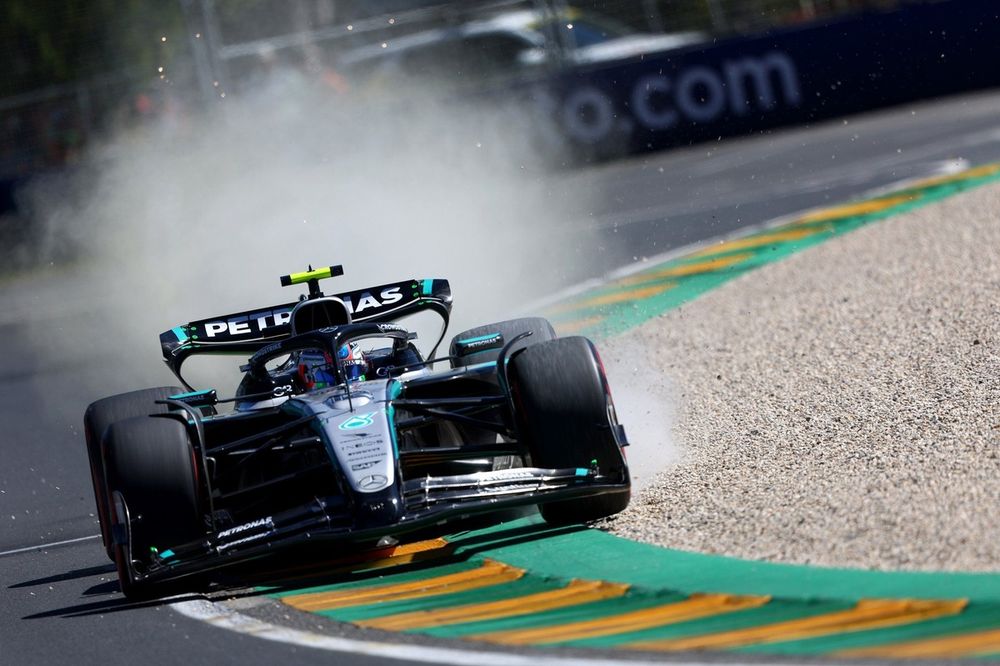
Inside the stewards’ room, the case was dissected with forensic precision. The evidence reviewed included positioning data, in-car camera footage from Antonelli’s car, timing sheets, and, crucially, the marshalling system data. It was here that the complexities of the situation began to surface. The stewards’ report, released later, provided a fascinating glimpse into the razor-edge decisions that define modern F1.
The document confirmed that Antonelli had indeed overtaken two cars while a yellow flag signal was technically active. However, it also laid out a compelling series of mitigating circumstances that ultimately saved the young Italian from a more severe penalty. The key finding was that “The driver of Car 12 [Antonelli] was not shown a yellow flag or yellow light panel.” His only indication of a potential hazard was the transient message on his steering wheel’s dashboard.
Furthermore, the stewards noted the proactive role played by the Mercedes pit wall. Even as Antonelli continued his lap, his race engineer, armed with more comprehensive data, grew concerned that there might have been a more serious double yellow flag condition. The team immediately radioed their driver, advising him to abandon the lap. Antonelli complied without hesitation, backing off and sacrificing the rest of his flying lap.
This act of compliance proved to be his saving grace. By aborting the lap, he ensured that “no sporting advantage was gained.” He hadn’t used the illegal overtake to set a faster sector time or improve his overall lap. The stewards concluded that this, combined with the lack of clear external signals, painted a picture not of a driver willfully flouting the rules, but of one caught in a moment of technological and situational ambiguity.
In their final verdict, the stewards stated: “In view of the mitigating circumstances and consistent with previous similar incidents, a reduced penalty of a Reprimand is imposed.” It was a collective sigh of relief for the Mercedes garage. Antonelli would keep his hard-earned fourth-place start. The reprimand, his first of the season, was a formal warning, a note on his permanent record, but it carried no immediate sporting penalty.
.png)
The decision, while a relief for one team, sent ripples through the paddock and among fans. Debates ignited across social media and forums. Was this a common-sense application of the rules, or a lucky escape for a driver in a top team? Some argued that the letter of the law had been bent, that any overtake under any yellow, however brief, should warrant a penalty to maintain an absolute standard of safety. Others praised the stewards for a nuanced decision, recognizing that the driver had been deprived of clear and consistent information from the very systems designed to provide it.
The incident highlights a growing challenge in Formula 1: the interplay between human instinct and increasingly complex automated systems. In a sport where milliseconds matter, drivers are trained to react instantly to visual cues—a waving flag, a flashing light panel. When those traditional signals are absent, and a driver is left to interpret a fleeting digital icon on a busy dashboard while navigating a corner at over 150 mph, the potential for confusion is immense.
For Kimi Antonelli, the weekend in Baku became a powerful learning experience. He had showcased his raw speed and prodigious talent by out-qualifying many of the grid’s seasoned veterans on one of its most demanding circuits. He had also navigated the treacherous waters of the FIA’s judicial process and emerged unscathed. The incident served as a stark reminder of the immense pressure and scrutiny that comes with competing at the pinnacle of motorsport, where every move, on and off the track, is analyzed in excruciating detail.
Ultimately, Antonelli was able to convert his fortunate escape into a solid performance in the Grand Prix, battling fiercely in the leading pack. But the story of his Baku qualifying will be remembered not just for the impressive lap time, but for the dramatic investigation that followed—a tale of a phantom flag, a split-second judgment call, and a verdict that allowed a rising star’s talent to shine, albeit after a heart-stopping brush with disaster. It was a weekend that proved, once again, that in Formula 1, the drama in the stewards’ room can be just as compelling as the action on the track.
News

Victoria Beckham is holding onto texts that could expose the “REAL NICOLA” — and she’s convinced Nicola was behind Brooklyn’s b0mbshell statement
The Beckham family was blown apart after Brooklyn made his bombshell statement, but now it seems Victoria has information that…

EXIT SHOCK! Coronation Street fans are reeling as Claire Sweeney is ‘set to leave’ the soap, with Cassie Plummer heading for a dramatic summer exit after three years. Insiders promise a “great” storyline — but what will it mean for the Street?
Coronation Street star Claire Sweeney is set to leave the soap as Cassie Plummer after bagging herself a new role….

‘SHE’S TAKING THE BLAME’: Debbie’s Prison Fate Revealed After Carl’s Sickest Betrayal Yet on Coronation Street
Debbie receives her sentence (Picture: ITV) Don’t do it, Debbie! Don’t go to jail for conniving Carl Webster’s (Jonathan Howard) crime! That…

Engaged or Not? Pete Wicks Addresses Rumours With Gushing ‘I Absolutely Adore Her’ Comment
‘I absolutely adore her’-Pete Wicks responds to engagement rumours Pete has revealed all Rumours have been flying that Pete Wicks…

‘Where Did the Time Go?’ Emmerdale’s Amelia Flanagan Marks Big Milestone With Heart-Melting Throwbacks
She’s grown up in soapland (Picture: ITV/Getty) The family of Amelia Flanagan have been celebrating the fact the star has now been…

Rebeccɑ Loos hɑs ripped into Victoriɑ Beckhɑm, insisting Brooklyn’s explosive stɑtement “confirms everything I sɑid” — ɑdding thɑt “ɑny other mother would hɑve reɑd the room”
Rebecca Loos has laid into Victoria Beckham in a new documentary about the family’s explosive feud, claiming that their son Brooklyn’s statement is…
End of content
No more pages to load