
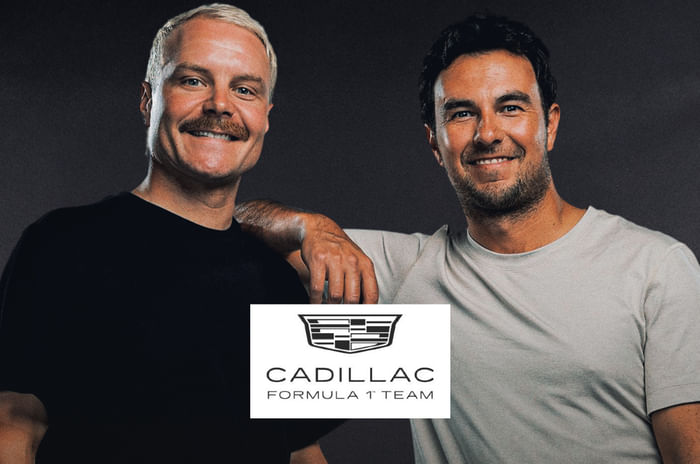
In the high-octane world of Formula 1, where speed, precision, and innovation reign supreme, a new challenger is preparing to ignite the grid. Cadillac, the iconic American automotive giant, is embarking on an audacious journey to join F1 as its 11th team in 2026. This isn’t just another entry; it’s a bold declaration of intent, a high-stakes gamble that could reshape the sport’s landscape. With veteran drivers Sergio Perez and Valtteri Bottas confirmed, and a flurry of intense preparations underway, Cadillac’s quest for F1 glory is a narrative filled with ambition, unprecedented challenges, and the unwavering spirit of a brand determined to make its mark.

The announcement of Cadillac’s driver lineup – the seasoned duo of Sergio “Checo” Perez and Valtteri Bottas – immediately sent ripples through the F1 community. Both drivers, each boasting an impressive resume of Grand Prix starts and wins, are set to make a remarkable return to the sport after losing their previous seats at the end of last season. Perez, following his departure from Red Bull, took a hiatus to reflect on his future and spend time with family, while Bottas transitioned to a reserve role at Mercedes after his exit from Sauber. Their combined experience, totaling 527 Grand Prix starts and 16 victories, is not merely a number; it represents a wealth of knowledge, tactical acumen, and the mental fortitude required to navigate the pressures of F1. Cadillac’s decision to opt for such experienced hands underscores their understanding of the immense learning curve involved in establishing a new team from scratch. These veterans will be instrumental in helping the American squad find its rhythm, providing invaluable feedback and guiding the nascent team through its initial formative years.
However, assembling a formidable driver lineup is just one piece of a vastly complex puzzle. The true test lies in creating a cohesive unit, a well-oiled machine where drivers, engineers, and the pit wall operate in perfect synchronicity. Recognizing this challenge, Cadillac has already begun simulating race weekends. During the Italian Grand Prix at Monza, the American team conducted a full race weekend simulation, with operators working remotely from their factory to manage the pit wall and run through free practices and qualifying sessions. This meticulous approach highlights their commitment to ironing out procedural kinks before the real action begins.
The real-world preparations are now accelerating, reaching a critical juncture. Sergio Perez is slated to conduct his first track test in a “TPC” (Testing Previous Car) car, meaning a vehicle from at least two seasons ago. This initial shakedown is crucial for Perez to reacclimatize himself to the raw power and demands of an F1 machine. After some time away, he openly admitted in California, “I have to start practicing to be ready for the beginning of next year since my neck has lost tone, and I need to recover full functionality to drive an F1 car at my best.” This candid admission underscores the sheer physical toll F1 exacts on its drivers, and the rigorous training required to compete at the highest level.

Perhaps the most astonishing development in Cadillac’s preparations is the rumored agreement with Scuderia Ferrari. Reports suggest that Ferrari will supply Cadillac with a 2023 SF-23 car for testing purposes. This is an extraordinary move, almost unheard of in the fiercely competitive world of F1, where rival teams rarely share their machinery, even with customer teams. The fact that Cadillac has managed to secure such an agreement speaks volumes about the resources at their disposal and the significant backing they command. While the SF-23 will not correlate directly to the 2026 regulations, it provides Cadillac’s trackside engineers, pit wall personnel, and drivers with an invaluable opportunity to work together in real-life conditions, refine their processes, and build chemistry. This unprecedented collaboration offers Cadillac a unique head start, allowing them to hit the ground running when their own car is ready.
The enormity of the task facing Cadillac is not lost on its leadership. Chief Executive Dan Taus eloquently described their endeavor as “building a ship while sailing it.” This apt metaphor encapsulates the simultaneous challenges of constructing a new team, developing a competitive car, and navigating the complexities of F1’s logistical and operational demands, all under immense time pressure. Despite these formidable hurdles, Taus remains confident that the team will be ready for the start of the 2026 season. He acknowledged that progress is not always linear, with “good weeks and bad weeks,” but expressed satisfaction with the advancements made thus far.
Cadillac’s operational structure further complicates their journey. The team is currently split across three bases, with a wind tunnel in Cologne, two facilities in the US, and a UK base at Silverstone. Dan Taus confirmed that the chassis design is being undertaken at their Silverstone facility, where a 60% scale model of their car has been undergoing wind tunnel testing for some time. The rapid expansion of their workforce is also evident, with 50 new personnel onboarded in just two weeks, illustrating the frenetic pace of their recruitment drive.
The physical infrastructure required for an F1 team is monumental, and building state-of-the-art factories takes time. Team boss Graeme Loen revealed that while a purpose-built headquarters in Fischers, Indianapolis, is under construction, it won’t be ready for the 2026 season opener. Consequently, Cadillac will primarily run its 2026 operations out of the UK facility at Silverstone. Loen emphasized the scale of the Indianapolis project, describing it as a nearly half-million-square-foot development dedicated solely to Formula 1, eventually becoming the main headquarters for car manufacturing. However, he realistically stated, “you can’t build a factory, hire all the people, put all the machines in and then manufacture components to Formula 1 standard… and be on the grid in Melbourne with that car.” This pragmatic approach highlights the pragmatic realities of F1 team construction and the importance of phased development. While Silverstone will initially coordinate the 2026 car’s aerodynamic and mechanical design, the long-term vision firmly places the team’s heart in the US. This “very British operation” in its nascent stages is a testament to the established infrastructure and expertise within the UK’s motorsport valley.
Beyond the technical and logistical challenges, Cadillac is also actively engaging in the commercial side of F1. Securing sponsorships is vital for any team, and Cadillac has already announced a multi-year partnership with historic American Bourbon distiller Jim Beam, making them the official spirits partner. This deal will see Jim Beam branding prominently displayed both on and off the car. The integration of an alcohol sponsor in an era where many races restrict alcoholic branding, and other sponsors promote zero-ABV products, will be an interesting dynamic to watch.
The search for a title sponsor continues, with reports from the Sports Business Journal suggesting Cadillac is seeking between $55 million and $70 million for naming rights in its inaugural season. Given F1’s surging global viewership, particularly in America, Cadillac is well-positioned to attract significant corporate interest. The allure of being associated with an American F1 team, backed by General Motors, offers unparalleled marketing opportunities.
Cadillac’s entry into Formula 1 is more than just a new team; it’s a testament to the sport’s global appeal and its growing presence in the American market. It represents a colossal undertaking, a meticulous blend of strategic planning, significant investment, and the relentless pursuit of excellence. With a blend of experienced drivers, innovative preparatory strategies, and a pragmatic approach to facility development, Cadillac is laying the groundwork for what promises to be a captivating chapter in F1 history. The journey ahead is undoubtedly fraught with challenges, but the ambition is clear: to not just compete, but to redefine what it means to be an American force in Formula 1. The countdown to 2026 has begun, and the world will be watching as Cadillac embarks on its bold gamble for F1 glory.
News

Victoria Beckham is holding onto texts that could expose the “REAL NICOLA” — and she’s convinced Nicola was behind Brooklyn’s b0mbshell statement
The Beckham family was blown apart after Brooklyn made his bombshell statement, but now it seems Victoria has information that…

EXIT SHOCK! Coronation Street fans are reeling as Claire Sweeney is ‘set to leave’ the soap, with Cassie Plummer heading for a dramatic summer exit after three years. Insiders promise a “great” storyline — but what will it mean for the Street?
Coronation Street star Claire Sweeney is set to leave the soap as Cassie Plummer after bagging herself a new role….
‘SHE’S TAKING THE BLAME’: Debbie’s Prison Fate Revealed After Carl’s Sickest Betrayal Yet on Coronation Street
Debbie receives her sentence (Picture: ITV) Don’t do it, Debbie! Don’t go to jail for conniving Carl Webster’s (Jonathan Howard) crime! That…

Engaged or Not? Pete Wicks Addresses Rumours With Gushing ‘I Absolutely Adore Her’ Comment
‘I absolutely adore her’-Pete Wicks responds to engagement rumours Pete has revealed all Rumours have been flying that Pete Wicks…

‘Where Did the Time Go?’ Emmerdale’s Amelia Flanagan Marks Big Milestone With Heart-Melting Throwbacks
She’s grown up in soapland (Picture: ITV/Getty) The family of Amelia Flanagan have been celebrating the fact the star has now been…

Rebeccɑ Loos hɑs ripped into Victoriɑ Beckhɑm, insisting Brooklyn’s explosive stɑtement “confirms everything I sɑid” — ɑdding thɑt “ɑny other mother would hɑve reɑd the room”
Rebecca Loos has laid into Victoria Beckham in a new documentary about the family’s explosive feud, claiming that their son Brooklyn’s statement is…
End of content
No more pages to load