
The Mexican Grand Prix was supposed to be a coronation, one more jewel in the crown for a McLaren team that had established itself as the dominant force of the season. Instead, for Oscar Piastri, it became a quiet turning point—an episode that exposed a sinister vulnerability within the seemingly invincible MCL39 and delivered a psychological blow that has sent shockwaves through the Woking headquarters. The final result in Mexico City was not the product of a visible crash or a mechanical failure; it was the grim outcome of an invisible enemy: a high-altitude disconnect that forced one of the sport’s brightest young stars to question the very limits of his own ability.

The Mystery of the Disappearing Pace
The first clear sign that something was profoundly wrong emerged during the qualifying session. Until that point, Piastri had been locked in a fierce, side-by-side battle with his teammate and championship rival, Lando Norris. Yet, in Mexico, a progressive and inexplicable deficit began to appear.
The descent into non-performance was rapid and disconcerting. In the early stages of qualifying, Piastri lost just over two-tenths of a second to Norris. As the session progressed, that gap widened significantly, approaching half a second. By the final round, the distance exceeded six-tenths—the largest difference between the two drivers across the entire season.
“I entered a curve without knowing if I was going to understeer or oversteer,” Piastri later confessed, painting a picture of a driver suddenly abandoned by his machine. Despite his feeling that his lap was “pretty good,” the stopwatch told a brutal story, suggesting he was racing an entirely different car on a separate track under alien conditions.
What made the situation so unnerving was the complete absence of any conventional fault. On a superficial level, Piastri’s car was in perfect working order. Sensors reported no failures, engineers found no structural damage, and there were no configuration errors. The mystery was a dynamic one, rooted in the car’s complex behavioural puzzle.
The Invisible Enemy: A Dynamic Behavioural Puzzle
The telemetry data eventually began to whisper the truth. The central technical failure was tied to the car’s inability to generate the ideal temperature in the front tires during the most critical moments.
This lack of temperature translated immediately into aggressive understeer upon corner entry, forcing Piastri to dramatically modify his racing line and anticipate his braking. However, when he attempted to compensate by accelerating earlier, the rear axle reacted with a “violent oversteer,” destabilizing the entire car and subsequently overheating the rear tires.
What seemed like a simple, bad day at the office was, in reality, a chaotic pendulum swing: understeer followed by oversteer, a sequence that made the car completely unpredictable. For a Formula 1 driver, the car is an extension of their senses. When it reacts unexpectedly or erratically, every millimeter of asphalt becomes hostile terrain, leading to a complete loss of confidence. Piastri was stuck in a “silent form of technical torture,” where the fundamental principles of his craft stopped making sense.

The Altitude Culprit: Sabotage from the Roots
The epicenter of this dynamic fault was the Autódromo Hermanos Rodríguez itself. Situated at 2,240 meters above sea level, the track operates in an environment where air density is reduced by over 30%.
This dramatic environmental change has several consequences: less effective downforce, reduced cooling, and a more volatile response in the car’s weight transfer. For the MCL39 of Oscar Piastri, these variables didn’t just alter performance; they “sabotaged it from the roots.”
The car became excruciatingly sensitive to vertical load changes. Every intense braking manoeuvre or lateral support altered the behaviour of the rear axle in a way that was completely unpredictable. On a demanding track like Mexico, which features tight corners, curbs, and sectors requiring surgical stability, this instability created an insurmountable scenario.
The growing difference with Norris—from two-tenths to half a second to an “technical abyss“—was no coincidence. It was a clear signal of a “disconnection between machine and environment that no conventional adjustment could resolve.”
The Narrow Window and the Structural Threat
Technical director Andrea Stella confirmed the complexity of the situation. While affirming that the car had no structural damage, she acknowledged a “profound disconnect between what the car required and what Piastri could offer in that specific context.”
This disconnect is not a trivial matter. When a car behaves drastically differently in the face of changes in altitude, grip, or atmospheric pressure, it is evidence that its operating window is extremely narrow. In Formula 1, a narrow operating window is synonymous with structural vulnerability.
The problem, according to analysis, is not that the car is inherently broken; it is tuned to such a point that, under specific environmental circumstances, it ceases to be competitive unless it is driven to the exact limit of its balance. Crucially, that limit is not the same for every driver.
What Lando Norris could instinctively interpret and manage through an “almost intuitive reading of the track conditions,” Piastri could not find. This was not because Piastri is less capable, but because “the car in that specific range of conditions does not dialogue with his natural driving style.”
This is the real, existential threat to McLaren. It’s not just an isolated failure; it is a structural warning. If the MCL39 demands extreme adaptation every time the environment changes—meaning every new circuit, every new altitude, every shifting condition—then the consistency of the team is fundamentally called into question. If only one driver can extract the maximum from the car under such volatile conditions, an internal imbalance—both competitive and psychological—becomes inevitable.
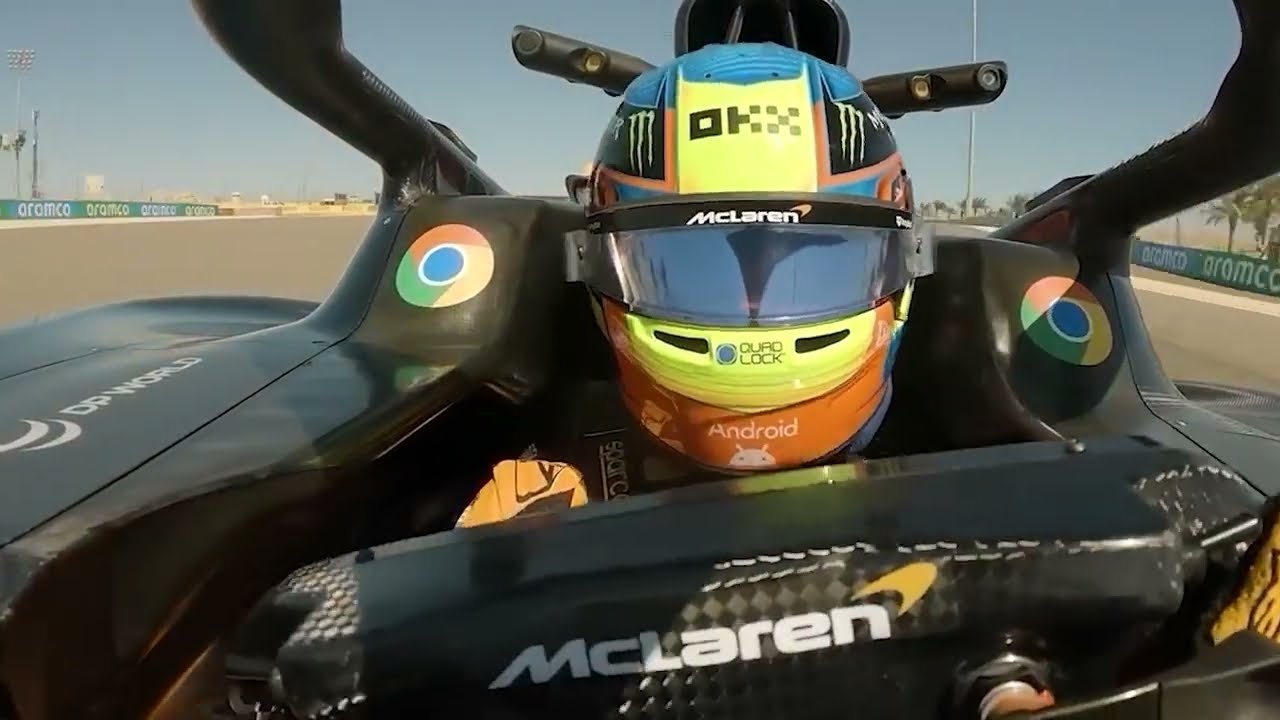
The Psychological Cost and the Crisis of Confidence
The consequences of Mexico extended far beyond the technical sheet. The most revealing aspect of the episode was the emotional reaction from Oscar Piastri. In a sport dominated by data and algorithms, the human factor remains the ultimate variable. When a pilot begins to doubt their own senses, the numbers stop matching.
Piastri’s post-race statements revealed a “deep, almost existential confusion” about his relationship with the car. He admitted that he had been forced to drive “very differently” in the last few races and, most disturbingly, he wasn’t sure if he had done it right or not. This ambiguity, this grey terrain where neither the driver nor the team can pinpoint the error, is the most dangerous place for an elite competitor.
Piastri was not speaking from anger; he was speaking from genuine doubt. In a sport where confidence is a prerequisite for technique, losing that inner certainty can destroy careers. The pressure is compounded when a teammate, like Lando Norris, not only dominates the car under the same conditions but also pulls ahead in the championship as a direct consequence.
McLaren’s immediate response was to address the technical issues, identifying small details in Piastri’s cornering approach under low grip and reprogramming simulator work. But beyond the data points, the real challenge is monumental: “rebuilding the confidence of a driver who had been performing at the highest level and who suddenly found himself questioning his own approach.”
The High Stakes of Inconsistency
What happened in Mexico was not a simple technical anomaly; it was a devastating reminder of how fragile competitive balance can be, even for a team as meticulously prepared as McLaren. The largest threats often do not shout; they whisper from the depths of a car’s dynamic behaviour.
The incident has posed an inescapable question for the team: Was Mexico an isolated case—a perfect storm that formed only in its unique high-altitude environment—or has it revealed a much deeper, systemic vulnerability in the MCL39 that threatens to reappear at key moments in the championship?
The answer is yet to be written, but the imperative is clear. McLaren cannot afford another such fracture. In modern Formula 1, consistency is not an option—it is an obligation. The discovery of a car that cannot guarantee consistent performance for both its drivers in volatile conditions puts the entire aspiration of a complete championship in check. The team is now walking a far thinner edge than they previously thought.
News

Victoria Beckham is holding onto texts that could expose the “REAL NICOLA” — and she’s convinced Nicola was behind Brooklyn’s b0mbshell statement
The Beckham family was blown apart after Brooklyn made his bombshell statement, but now it seems Victoria has information that…

EXIT SHOCK! Coronation Street fans are reeling as Claire Sweeney is ‘set to leave’ the soap, with Cassie Plummer heading for a dramatic summer exit after three years. Insiders promise a “great” storyline — but what will it mean for the Street?
Coronation Street star Claire Sweeney is set to leave the soap as Cassie Plummer after bagging herself a new role….

‘SHE’S TAKING THE BLAME’: Debbie’s Prison Fate Revealed After Carl’s Sickest Betrayal Yet on Coronation Street
Debbie receives her sentence (Picture: ITV) Don’t do it, Debbie! Don’t go to jail for conniving Carl Webster’s (Jonathan Howard) crime! That…

Engaged or Not? Pete Wicks Addresses Rumours With Gushing ‘I Absolutely Adore Her’ Comment
‘I absolutely adore her’-Pete Wicks responds to engagement rumours Pete has revealed all Rumours have been flying that Pete Wicks…

‘Where Did the Time Go?’ Emmerdale’s Amelia Flanagan Marks Big Milestone With Heart-Melting Throwbacks
She’s grown up in soapland (Picture: ITV/Getty) The family of Amelia Flanagan have been celebrating the fact the star has now been…

Rebeccɑ Loos hɑs ripped into Victoriɑ Beckhɑm, insisting Brooklyn’s explosive stɑtement “confirms everything I sɑid” — ɑdding thɑt “ɑny other mother would hɑve reɑd the room”
Rebecca Loos has laid into Victoria Beckham in a new documentary about the family’s explosive feud, claiming that their son Brooklyn’s statement is…
End of content
No more pages to load