
The dazzling lights of Singapore’s Marina Bay circuit often illuminate moments of Formula 1 glory, but for McLaren, the recent Grand Prix cast a long, ominous shadow. What began as a season brimming with promise, a unified pursuit of championship titles, has seemingly spiraled into an all-out internal crisis, threatening to tear the legendary team apart. The catalyst? An aggressive on-track maneuver by Lando Norris against his teammate Oscar Piastri, an incident that has exposed a simmering psychological and emotional battle within the papaya orange garage.
Piastri’s furious radio message – “Are we cool with Lando just barging me out of the way?” – encapsulated the immediate shock felt by millions of viewers worldwide. It wasn’t merely a question of track position; it was a plea for clarity, a desperate search for fairness in a moment where the bedrock of team unity appeared to crumble. The silence that followed from the McLaren pit wall, the absence of penalty or team orders, spoke volumes, signaling that something profound had indeed broken within the team.
Team Principal Zak Brown’s insistence that they were simply “letting them race” rings hollow to many F1 experts, including the seasoned commentator Martin Brundle. Brundle, known for his incisive observations, believes this rivalry has reached a critical juncture, a “point of no return.” McLaren’s carefully constructed unity, once seen as their greatest asset in challenging the likes of Red Bull, now appears to be collapsing in real-time, jeopardizing their championship aspirations.

The Slow Burn: A Season of Shifting Loyalties
The Singapore incident wasn’t an isolated event; it was the dramatic explosion of tensions that had been quietly building for months. Early in the season, Oscar Piastri was widely regarded as McLaren’s “golden boy.” His calm demeanor, precise driving, and ruthless efficiency brought a much-needed consistency in points, instilling a quiet confidence that McLaren could finally challenge the Red Bull dominance.
However, as the season progressed, a subtle but significant shift began to emerge. Whispers turned into murmurs as team radio calls, strategy decisions, pit stop timings, tire priorities, and even aerodynamic updates seemed to increasingly favor Lando Norris. The perception, for many, was that McLaren’s much-vaunted “equal treatment” policy was more myth than reality.
The first major crack appeared during the Italian Grand Prix. After Norris suffered a slow pit stop, the team issued a controversial order: Piastri was told to relinquish the position he had rightfully earned on track. At the time, it was framed as a “team-first decision,” seemingly harmless. Yet, in hindsight, this moment was pivotal. It was the instant Piastri likely realized that within McLaren, “fairness wasn’t always guaranteed.” This seed of doubt, planted early in the season, would fester and ultimately blossom into open conflict.
Singapore: The Point of No Return
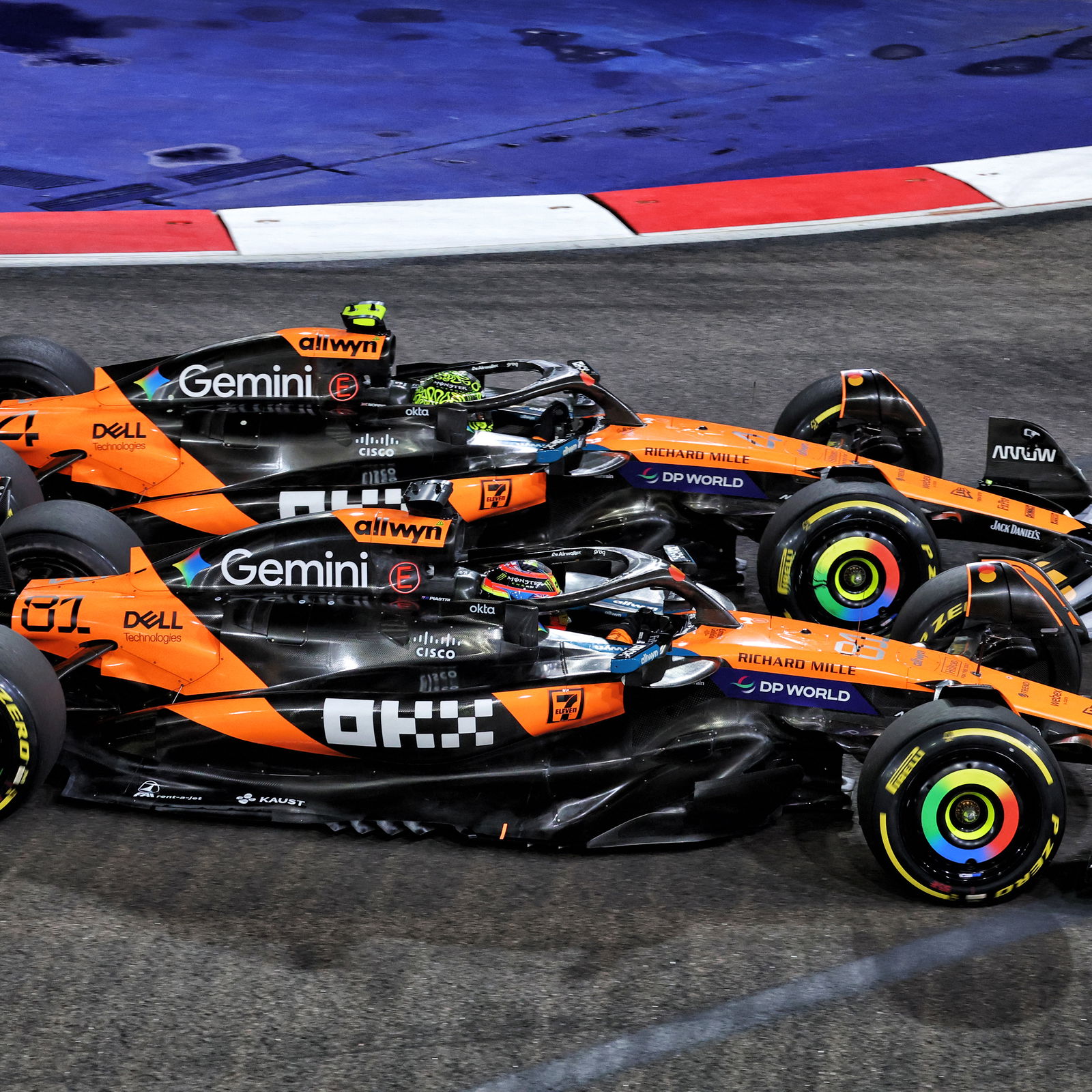
Fast forward to Singapore, a race crucial for McLaren’s constructor’s championship hopes. Instead of a display of unity, the team’s two drivers engaged in what many described as a “war.” Norris’s move on Piastri was audacious, some might even say desperate, forcing the Australian off the racing line. While the contact was light, its symbolic weight was immense. McLaren’s golden rule – “no contact between drivers” – had been shattered.
When the dust settled, Piastri’s frustration boiled over, his angry radio message a stark revelation of the depth of the wound. The subsequent silence from McLaren – the lack of intervention, the absence of a penalty – effectively legitimized Norris’s aggression in Piastri’s eyes, deepening the sense of betrayal. Zak Brown’s explanation of “letting them race” was interpreted by many as a tacit endorsement of Norris’s actions, implying that the team was unwilling to take sides, even if it meant alienating one of their drivers.
Martin Brundle’s assessment hit home: “the relationship between the two McLaren drivers will irrevocably change.” He correctly observed that once trust is broken at this level, it rarely, if ever, returns. Brundle further cautioned that while McLaren might choose to “let them duke it out,” they would inevitably face the costly consequences of damaged cars, lost championship points, and the relentless pursuit of Max Verstappen and Red Bull.

The Paddock Whispers: Isolation and Betrayal
Behind the veneer of post-race smiles and PR statements, the situation inside McLaren’s garage reportedly grew even more dramatic. Reports circulated that Piastri, deeply incensed, disconnected his team radio after the race and conspicuously skipped McLaren’s constructor’s title celebration. He was allegedly seen leaving the paddock alone, a poignant image of a driver feeling isolated and marginalized within his own team.
Former F1 driver David Coulthard, drawing on his own experiences at McLaren during the fiercely competitive Mika Häkkinen era, sharply criticized the team’s handling of the situation. He unequivocally stated that McLaren had “got Pastry offside.” Coulthard’s words carried significant weight, highlighting a deeper issue beyond mere performance: “emotional fairness.” In the high-stakes world of Formula 1, trust is paramount, and when a driver perceives that his team doesn’t have his back, that trust rapidly evaporates. This, Coulthard suggested, is precisely what is afflicting Piastri now.
The Ferrari Bombshell: A Future in Red?
Just when the McLaren drama seemed to reach its peak, an astonishing twist emerged: a bombshell report from the Swiss publication Blick suggested that Oscar Piastri might be “eyeing a move to Ferrari.” On the surface, this sounds improbable. McLaren had only recently announced Piastri’s multi-year extension.
However, contracts in Formula 1, particularly for top-tier talent, are rarely ironclad. If relationships within a team deteriorate beyond repair, “escape clauses” can become incredibly tempting. The timing of these rumors is also significant. Formula 1’s impending regulation overhaul is widely expected to trigger a massive driver reshuffle across the grid.
Ferrari’s current lineup of Charles Leclerc and Lewis Hamilton might not remain stable. Leclerc’s “long-term patience with Ferrari’s underperformance is wearing thin,” while Hamilton’s contract reportedly contains an expiration option. Should either driver depart, a coveted seat at Maranello would open up, and Piastri’s name is already being “whispered in Marinelo corridors.”
The Dangerous Implications for McLaren
For McLaren, the implications of this internal strife and the burgeoning Ferrari rumors are dire. What was once hailed as one of the “strongest driver pairings in decades” is rapidly transforming into their biggest liability. Norris, seemingly “emboldened by recent wins,” has closed the championship gap to Piastri. Conversely, Piastri has seen his championship challenge falter, losing ground in three consecutive races.
The Australian’s renowned composure is being severely tested, and the paddock is abuzz with speculation. Some insiders suggest Piastri is “cracking under pressure,” but a more nuanced perspective suggests he is simply reacting as any top-tier driver would when sensing betrayal and a lack of support.
Zak Brown’s steadfast refusal to intervene, while perhaps intended to project neutrality, risks backfiring spectacularly. History is replete with cautionary tales of what happens when teams allow their drivers unfettered “racing.” The legendary rivalry between Ayrton Senna and Alain Prost famously “destroyed McLaren’s unity.” More recently, the intense animosity between Lewis Hamilton and Nico Rosberg “tore Mercedes apart from the inside.” Rivalries without clear boundaries and authoritative management almost always end in “chaos, broken relationships, and lost championships.”
As the F1 circus prepares for the upcoming Grand Prix in Austin, the McLaren garage will be under an unprecedented level of scrutiny. Cameras will zoom in on every interaction, every handshake, every pit wall exchange, and every piece of body language between Norris and Piastri. This is no longer just a sporting rivalry; it has morphed into a psychological war.
Unless Zak Brown steps in decisively and with clear authority, McLaren risks watching both of their prodigiously talented drivers “self-destruct.” The true tragedy would be for McLaren’s long-awaited return to the pinnacle of Formula 1 to collapse, not due to the might of Red Bull or Ferrari, but from internal politics, ego, and mistrust. The question is no longer whether McLaren can win a title, but rather, whether they can survive their own success.
If Piastri’s frustration continues to mount, and if Ferrari’s interest genuinely solidifies, McLaren might soon face the harrowing realization that they have not only lost control of a championship fight but potentially the future of their team. The coming races will reveal whether McLaren can mend these fractured bonds or if the tension will lead to the unimaginable: Oscar Piastri, clad in the iconic Ferrari red. The fate of McLaren’s championship hopes, and perhaps Piastri’s career, now hangs precariously in the balance.
News

Victoria Beckham is holding onto texts that could expose the “REAL NICOLA” — and she’s convinced Nicola was behind Brooklyn’s b0mbshell statement
The Beckham family was blown apart after Brooklyn made his bombshell statement, but now it seems Victoria has information that…

EXIT SHOCK! Coronation Street fans are reeling as Claire Sweeney is ‘set to leave’ the soap, with Cassie Plummer heading for a dramatic summer exit after three years. Insiders promise a “great” storyline — but what will it mean for the Street?
Coronation Street star Claire Sweeney is set to leave the soap as Cassie Plummer after bagging herself a new role….

‘SHE’S TAKING THE BLAME’: Debbie’s Prison Fate Revealed After Carl’s Sickest Betrayal Yet on Coronation Street
Debbie receives her sentence (Picture: ITV) Don’t do it, Debbie! Don’t go to jail for conniving Carl Webster’s (Jonathan Howard) crime! That…

Engaged or Not? Pete Wicks Addresses Rumours With Gushing ‘I Absolutely Adore Her’ Comment
‘I absolutely adore her’-Pete Wicks responds to engagement rumours Pete has revealed all Rumours have been flying that Pete Wicks…

‘Where Did the Time Go?’ Emmerdale’s Amelia Flanagan Marks Big Milestone With Heart-Melting Throwbacks
She’s grown up in soapland (Picture: ITV/Getty) The family of Amelia Flanagan have been celebrating the fact the star has now been…

Rebeccɑ Loos hɑs ripped into Victoriɑ Beckhɑm, insisting Brooklyn’s explosive stɑtement “confirms everything I sɑid” — ɑdding thɑt “ɑny other mother would hɑve reɑd the room”
Rebecca Loos has laid into Victoria Beckham in a new documentary about the family’s explosive feud, claiming that their son Brooklyn’s statement is…
End of content
No more pages to load