
As Formula 1 hurtles toward its new hybrid engine era in 2026, all eyes are on the revolutionary technical regulations and the immense challenges they present. Yet, amidst this landscape of monumental change, Mercedes-Benz, a name synonymous with the pinnacle of the sport, is quietly executing a strategy that many believe will grant them an “invisible” yet incredibly powerful advantage: the complete control over a massive flow of data from four customer teams. This isn’t just a conventional tactical move; it’s a masterstroke that could reshape the championship battle for years to come.
The Core Changes in the 2026 Engine Regulations
To grasp the significance of Mercedes’ strategy, we must first understand what awaits the teams in 2026. The new power unit will feature a radically different configuration. Specifically, the MGU-H (Motor Generator Unit – Heat), which recovers energy from exhaust gas heat, will be completely eliminated. In its place, the MGU-K (Motor Generator Unit – Kinetic), the system that converts kinetic energy into electricity during braking, will play a more crucial role than ever. Its power output will surge from 120 kW to a staggering 350 kW—nearly triple the electrical power available on each lap. This will force teams to rethink everything from thermal management to chassis design.
Furthermore, the fuel will undergo a significant transformation. F1 will switch to 100% sustainable fuels, produced from non-fossil compounds. This presents not only a challenge in terms of combustion and pressure but also demands a complete recalibration of engine maps and torque delivery curves. Power units will likely no longer be based on pure internal combustion performance. Instead, success will hinge on a far more complex balance, requiring higher technical precision and navigating greater uncertainty. It is within this volatile context that Mercedes’ master plan truly comes into play.
An Unmatched Competitive Advantage
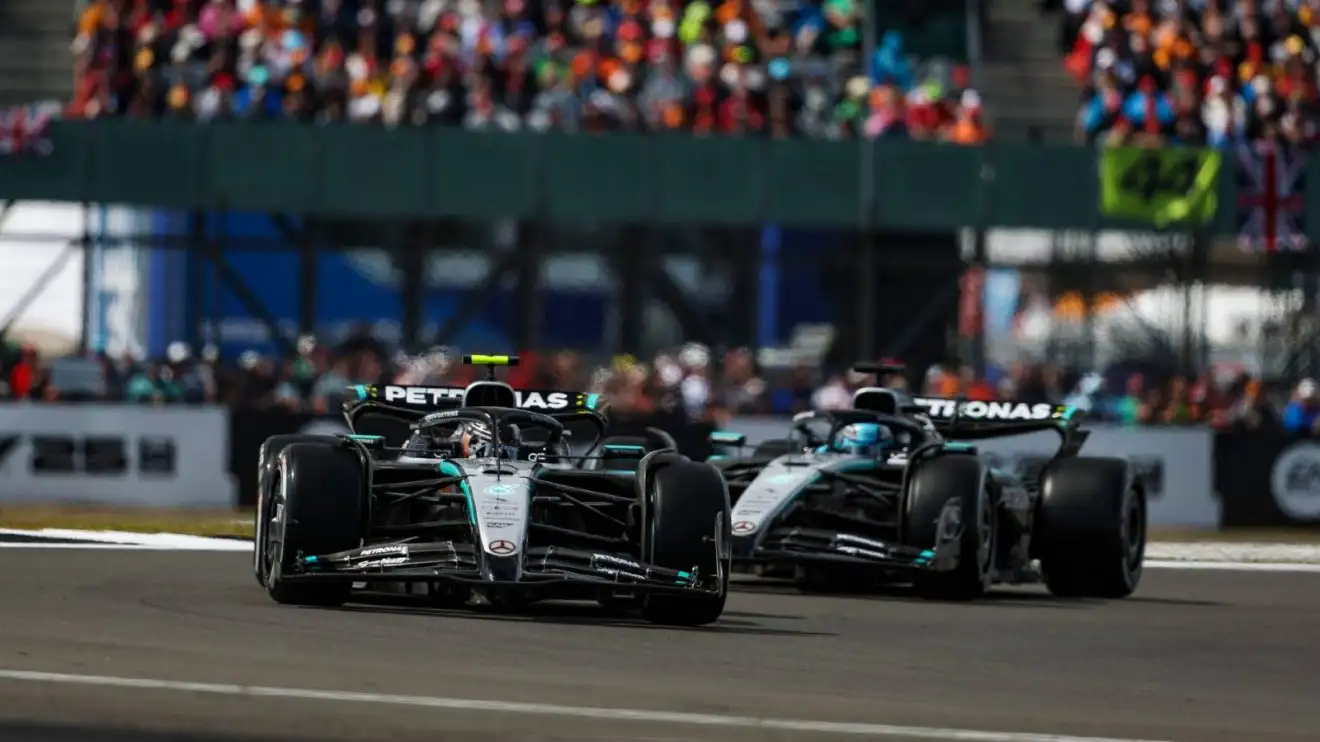
While other manufacturers like Audi and Honda have decided to limit their reach to just two teams, and Red Bull Powertrains will almost exclusively power its own team and Racing Bulls, Mercedes has emerged as the silent giant of the paddock. A remarkable four teams—Mercedes, McLaren, Williams, and Alpine—will be equipped with their power units. This translates to a total of eight cars, eight “mobile laboratories” spread across the grid, operating under real-world conditions with different drivers, diverse strategies, and varying weather scenarios. It’s a testing ground that no other manufacturer can possibly match.
This is no coincidence; it’s a deliberate, long-term strategy. For years, Mercedes has cultivated strong relationships with its customer teams, treating them not as minor clients but as genuine technical partners. This approach has allowed Mercedes to extend its influence far beyond its headquarters in Brackley and Brixworth. In 2026, while other manufacturers will have to rely on data from just two cars each weekend, Mercedes will have access to data from eight. This simple multiplication of data inputs represents a tactical advantage that, in a completely new regulatory environment, could be the deciding factor between adapting swiftly and being left behind.
The Alpine Deal: A Double Win
Adding another layer to this strategy is a move many have overlooked: the partnership with Alpine. The French team, which has a history of using its own Renault engines, is abandoning its in-house power unit program to place its trust in Mercedes. This means Mercedes not only gains another allied team but also inherits a vast amount of know-how that Alpine has accumulated over the years. Cross-information, different engineering approaches, and a new line of collaboration could yield unexpected breakthroughs. The 2026 grid will no longer be organized by the pure performance of the previous year; it will be reconfigured based on who can adapt fastest to the new regulations. And Mercedes, from the shadows, has achieved something no other brand has: becoming the development axis for more than a third of the cars on the track.

Distributed Intelligence: The Secret Weapon
In a world where technical knowledge is the most valuable currency, Mercedes not only has more of it than anyone else but has also found a way to multiply it without running a single extra kilometer. What does this mean for the championship? The fight for titles will no longer be solely between drivers or cars; it will be a battle of distributed intelligence, information networks, algorithms, and sensors. And in that new game, Mercedes already has a head start before the lights even go out for the first time.
Formula 1 has always been a technological war, but in 2026, that war will change its form. The winner won’t be the one with the most powerful engine, but the one who learns the fastest. This is where Mercedes has placed its greatest bet: an intelligence network distributed across eight cars, interconnected by a data stream that flows directly to its Brixworth headquarters, the heart of its high-performance engine division.
When regulations change as radically as they will in 2026, initial real-world data is worth more than any prior simulation. Test benches can only replicate certain conditions, but the track is a different beast entirely. Only the track can reveal true thermal degradation, power fluctuations, dynamic pressure variables, aggressive braking styles, intermittent energy management, or the erratic behavior of the MGU-K during a yellow flag or safety car restart.
With eight active power units every weekend, Mercedes will have the capacity to collect a critical mass of real-time data that no other manufacturer can match. It’s not just about the quantity but also the diversity. They will have engines in cars starting from pole and in others battling in the mid-pack. They will see how their power unit behaves in aggressive undercut strategies and in long stints focused on energy conservation, in rain and extreme heat, on low- and high-downforce circuits. Every kilometer driven by any of those cars will be another line of code in Mercedes’ intelligence system.
Proactive Learning and Risk-Free Testing
This data collection is not a passive process; it’s not limited to storing information. It is an active learning tool. During every race and practice session, Mercedes engineers will not only collect information but also process it in real time, detect anomalies, simulate scenarios, and generate solutions before a problem can be repeated. This system allows them to develop specific improvements that can then be applied in a controlled manner on one of the customer teams before being integrated into their official works team. It’s like having eight prototypes evolving simultaneously but under a single technical brain.
This accelerated learning capacity becomes even more critical when we consider reliability. In 2026, with the disappearance of the MGU-H and the reconfiguration of the power unit, mechanical failures are likely to be more frequent, at least in the first few races. Identifying patterns before they cause a retirement is a skill that can only be achieved with a large sample size. A manufacturer with only two cars might need several races to isolate a pattern; Mercedes could potentially do it in a single weekend.
Andrew Shovlin made this clear back in 2014 when Mercedes dominated the beginning of the hybrid era. One of their greatest advantages was precisely this: their customer teams helped them understand engine behavior faster, detect vulnerabilities, and optimize energy maps. That lesson was not forgotten; it was systematized, and now, for 2026, they are repeating the play on a much grander scale.
Furthermore, there is a non-technical component: trust. Customer teams using Mercedes engines are often more willing to share strategic data, driver feedback, and telemetry records. That transparency is not accidental; it is the result of years of collaboration and a reputation built on facts. While some manufacturers jealously guard their developments, Mercedes has created a technical community around them. In practice, that community functions as a decentralized laboratory. In this ecosystem, even mistakes become assets. If a failure occurs on a Williams or an Alpine, it is highly likely that it will not happen again on a McLaren or a Mercedes. Each customer car is an advanced trench in the development war, and every sensor mounted on an Alpine or a Williams reports directly to the Brixworth headquarters as if it were part of the main team.

Political Power in the Paddock
When the lights go out at the first race of 2026, many will be watching the front row, hoping to see which team has taken the lead. But the true strategists will know that the battle began much earlier: in the data centers, in the simulators, and in the spreadsheets comparing cross-referenced data from eight different cars. Mercedes isn’t just looking to win a race; it’s looking to establish an ecosystem, a model of dominance that depends not on winning on the track but on controlling the pace of technical learning.
They can take risks without risk. If they want to test a new component, a new thermal configuration for the ERS, or even an alternative combustion map adapted to a new biofuel, they don’t have to do it on their main team. They can implement small variations on a Williams or an Alpine, observe, compare, validate, and only then incorporate the successful change. It’s like playing chess with multiple pieces simultaneously while the rest of the manufacturers are carefully moving a single pawn.
But this goes beyond the technical aspect. It is also a statement of power within the paddock. When a manufacturer supplies the largest number of teams, it also gains political weight. Its decisions influence more teams, its voice carries more weight in F1 Commission meetings, and its interests are represented by more votes. In a context where crucial issues like the technical budget cap, profit distribution, or the standardization of certain components will be debated, that is as valuable as a second per lap.
Mercedes is not just building a winning car; it is building a system. It’s an interconnected environment where every kilometer traveled by its clients provides privileged information, where every mistake made by Alpine or Williams becomes a preventative success for the official team, and where every technical advance from McLaren can be redirected to Brixworth with an efficiency that borders on collective engineering intelligence.
This brings us to a final question: Is Mercedes still simply an engine supplier, or are we witnessing a deeper transformation? Are we witnessing the birth of a new model of power in Formula 1—one that no longer depends on pure speed but on shared knowledge, accelerated learning, and the invisible dominion of data flow? The answer lies in their ability to adapt and exploit this data, a strategy that is already placing Mercedes in pole position for the promising new era of F1 in 2026.
News

Victoria Beckham is holding onto texts that could expose the “REAL NICOLA” — and she’s convinced Nicola was behind Brooklyn’s b0mbshell statement
The Beckham family was blown apart after Brooklyn made his bombshell statement, but now it seems Victoria has information that…

EXIT SHOCK! Coronation Street fans are reeling as Claire Sweeney is ‘set to leave’ the soap, with Cassie Plummer heading for a dramatic summer exit after three years. Insiders promise a “great” storyline — but what will it mean for the Street?
Coronation Street star Claire Sweeney is set to leave the soap as Cassie Plummer after bagging herself a new role….

‘SHE’S TAKING THE BLAME’: Debbie’s Prison Fate Revealed After Carl’s Sickest Betrayal Yet on Coronation Street
Debbie receives her sentence (Picture: ITV) Don’t do it, Debbie! Don’t go to jail for conniving Carl Webster’s (Jonathan Howard) crime! That…

Engaged or Not? Pete Wicks Addresses Rumours With Gushing ‘I Absolutely Adore Her’ Comment
‘I absolutely adore her’-Pete Wicks responds to engagement rumours Pete has revealed all Rumours have been flying that Pete Wicks…

‘Where Did the Time Go?’ Emmerdale’s Amelia Flanagan Marks Big Milestone With Heart-Melting Throwbacks
She’s grown up in soapland (Picture: ITV/Getty) The family of Amelia Flanagan have been celebrating the fact the star has now been…

Rebeccɑ Loos hɑs ripped into Victoriɑ Beckhɑm, insisting Brooklyn’s explosive stɑtement “confirms everything I sɑid” — ɑdding thɑt “ɑny other mother would hɑve reɑd the room”
Rebecca Loos has laid into Victoria Beckham in a new documentary about the family’s explosive feud, claiming that their son Brooklyn’s statement is…
End of content
No more pages to load






