Michael Schumacher was more than just a great driver. His name, synonymous with speed, courage, and a relentless competitive spirit, is etched into the minds of millions of fans worldwide. But beyond the spectacular overtakes and unparalleled car control, Schumacher possessed another special talent, an innate tactical ability that transformed him from an excellent driver into an immortal legend: the capacity to read a race, make bold decisions, and turn the tide in his favor. This wasn’t just about “pit-stop calculations”; it was an art of strategy, a mind game between genius and risk.
Schumacher’s illustrious career spanned decades, seeing him claim seven world championships—a record that would only be matched much later by Lewis Hamilton. But what truly made him stand out was the way he and race engineer Ross Brawn worked together, creating a perfect “dynamic duo” capable of devising strategies no one saw coming. From cunning moves that exploited legal loopholes to daring tire choices in treacherous weather, every step Schumacher took was a lesson in acuity and decisiveness. Let’s revisit the moments of tactical brilliance where Michael Schumacher truly proved he was a “Red Baron,” not just on the track, but in strategic thinking.

1999 Malaysian Grand Prix: The Unsung Hero’s Role
After a horrific crash at Silverstone left him with a broken leg, Schumacher missed a large part of the 1999 season. When he returned to the track at the Malaysian Grand Prix, he was out of the championship fight, but his goal was to support his teammate Eddie Irvine in securing the title. In a masterful performance, Schumacher took pole position by an impressive full second. However, instead of holding the lead, he ceded the position to Irvine just three laps in. He then deliberately slowed down to allow the lighter-fueled Irvine to build a 20-second cushion. This tactic sabotaged McLaren’s plans for Mika Häkkinen and ultimately secured a historic 1-2 finish for Ferrari. Though Häkkinen went on to win the championship that year, this performance confirmed Schumacher as a tactical mastermind, even when playing a supporting role.
2000 Japanese Grand Prix: Breaking the Curse
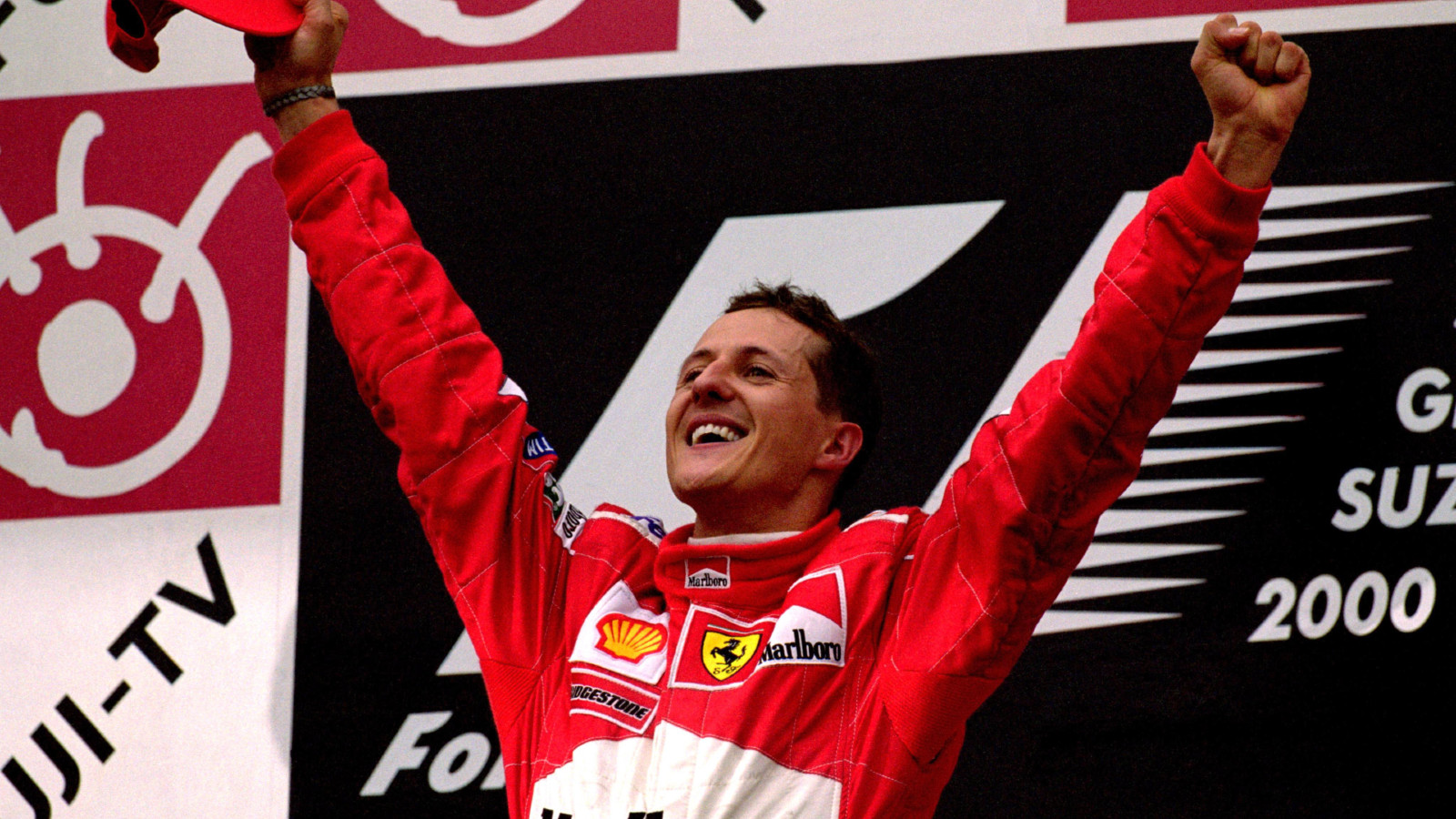
The pressure was immense on Schumacher and Ferrari heading into the 2000 season after several years of narrowly missing the championship. It was seen as a “make or break” year. Schumacher had led the standings from the first race and had a chance to clinch the title in Japan. After starting on pole, he was overtaken by Häkkinen at the start. Unable to get past Häkkinen in the first stint, Schumacher and Ross Brawn decided to extend the second stint. Then Schumacher did what he did best: a series of blistering, “wind-ripping” laps. He emerged from his second pit stop ahead of his rival, despite being slowed by yellow flags. Ultimately, he won the race, securing Ferrari’s first world championship in 21 long years and his third career title.
1997 Monaco Grand Prix: Seizing the Opportunity in the Rain
Schumacher’s second season with Ferrari was an uphill battle against the superior Williams car. In Monaco, he started behind the Williams duo. But just minutes before the race, a sudden downpour hit the circuit. While the two Williams cars opted to stay on slick tires, Schumacher made a bold call: switch to wets. This decision paid off instantly. As the Williams drivers struggled for grip, Schumacher shot into the lead, building a colossal 16-second gap after just the first lap. With a masterful drive in the wet, he won by a margin of over 53 seconds, briefly taking the championship lead from Villeneuve.
2005 San Marino Grand Prix: A Phenomenal Comeback
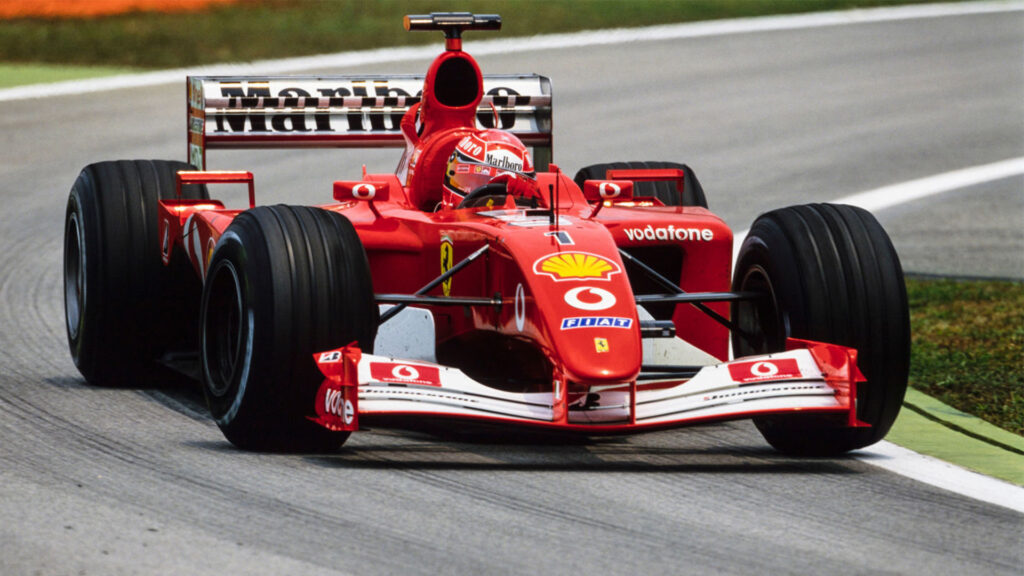
Following controversial rule changes designed to slow Ferrari down, Schumacher struggled with an uncompetitive car in 2005. But that didn’t stop him from delivering one of his most underrated performances at Imola. Starting from 13th, Schumacher opted for an unconventional strategy: instead of two short stints, he ran two long opening stints. With rules not allowing tire changes, he knew the overcut would be effective, giving him a clear track without the disadvantage of slower rubber. After the first stint, Schumacher emerged from the pits in third place. He quickly chased down and passed Jenson Button for second. With a much shorter final pit stop and a lighter fuel load, he slashed the gap to leader Fernando Alonso. After an epic duel, Alonso crossed the finish line just 0.2 seconds ahead. Schumacher had pulled off a miraculous recovery, going from 13th on the grid to narrowly missing out on a win.
1998 British Grand Prix: A Cunning Loophole Maneuver
Schumacher’s win at the 1998 British Grand Prix might not have been as epic as others, but it showcased his ability to find solutions on the fly. On a soaking wet Silverstone track, Schumacher fell nearly a full minute behind Mika Häkkinen. However, Häkkinen made multiple mistakes, allowing Schumacher to pass. When the safety car was deployed with 17 laps to go, Schumacher accidentally overtook Alexander Wurz’s Benetton under yellow flags. Race control issued a 10-second stop-and-go penalty but only announced the verdict with two laps remaining. Schumacher then did the unthinkable. On the final lap, he entered the pits to serve his penalty. However, Ferrari’s pit box was located past the start/finish line, meaning Schumacher had crossed the line to win the race before serving the penalty. It was a cheeky move that perfectly exploited a grey area in the rules. Ultimately, due to several errors from race control, the penalty was rescinded, but Schumacher’s clever move went down in F1 history as one of his best tactical calls.
1992 Belgian Grand Prix: A Smart Maiden Victory
Schumacher made his F1 debut at the legendary Spa-Francorchamps circuit in 1991 and impressed enough to secure a drive with Benetton after just one start. A year later, the iconic Belgian track witnessed his first career win. In a wet-dry race, Schumacher went off track with 15 laps to go, dropping behind his teammate Martin Brundle. However, the German driver noticed a blister forming on Brundle’s wet-weather tires—a sign the track was becoming dry enough for slicks. With a two-lap jump on the competition, Schumacher made the bold call to come in for a set of dry-weather tires. Once the rest of the field made the switch, the young German inherited a colossal lead. In the end, he crossed the line with a 36-second gap to score his maiden win, one that already showcased Michael Schumacher’s tactical genius.
2004 French Grand Prix: The Unthinkable Four-Stop Strategy
The 2004 season was a magical one for Schumacher and Ferrari. Aboard the famous F2004, the German won the first five races, matching Nigel Mansell’s 1992 record. He then followed it up with another seven in a row after Monaco, equaling Alberto Ascari’s record for the most consecutive wins. The most special one from that streak came at Magny-Cours. Schumacher started the French Grand Prix from second behind Fernando Alonso. He followed Alonso closely for two stints but couldn’t find a way by, as the twisty Magny-Cours layout made overtaking almost impossible. And then Schumacher and Ross Brawn made a bold call: go for an extra pit stop to try and leapfrog Alonso. Having short-fueled during the second pit stop, Schumacher emerged ahead of Alonso. He kept the lead after the third pit stop, and then the magic happened. With a clean track ahead of him, Schumacher did what he did best: running a qualifying stint. The German legend delivered a sequence of blistering laps to build a 21-second lead. He made the fourth and final pit stop with 12 laps to go and returned to the track comfortably ahead of Alonso. In the end, even with an extra pit stop, the German crossed the line to win by 8 seconds. With that, Schumi set a new F1 record for the most pit stops by a race winner.
1995 Belgian Grand Prix: The Rainmaster
Schumacher was also one of F1’s best in the wet, which earned him the nickname “Regenmeister” (Rainmaster). One of his greatest tactical masterpieces was the 1995 Belgian Grand Prix. A master of Spa, Schumi holds the F1 record at the legendary venue with six wins. His 1995 triumph came in a classic Spa race with constantly changing weather. Starting way back in 16th, the German methodically carved his way up the order. On lap 16, he took the lead when Damon Hill pitted for new tires. The rain started to fall, prompting Hill to pit for wets. Schumacher, however, decided to gamble and brave the wet track on a worn set of slicks. Hill had little trouble closing the gap, lapping considerably quicker. However, despite his massive pace advantage, Hill was unable to get by the German’s Benetton, with Schumacher putting on an aggressive defensive drive. The Brit briefly got by on lap 25 but was passed again on the following lap. With the track now almost completely dry, Hill was forced to pit again for slicks, handing Schumacher an even bigger lead. Once again, Schumi had shown his immense talent in the wet, driving with worn slicks on a slippery surface while fending off attacks from a much quicker car. Following another shower, both drivers pitted for wets, and Schumacher went on to win the race by nearly 20 seconds.
1998 Hungarian Grand Prix: 19 Blistering Qualifying Laps
Schumacher’s ability to deliver qualifying laps whenever he had a clear track ahead was arguably his best trait. The German was deadly on short stints and in-laps, often using them to deliver the decisive blow. Starting third around the tight and twisty Hungaroring, Schumacher didn’t have the pace or the track space to overtake the two much faster McLarens ahead. Working with Brawn, Schumi decided to roll the dice, switching to a three-stopper on the fly. This meant he would have to make one more pit stop than the two leading cars. It also meant Schumacher would need to drive a qualifying stint to make up for the speed deficit and the extra stop. Brawn radioed his driver: “Michael, you have 19 laps to pull out 25 seconds. We need 19 qualifying laps from you”. Schumi replied with nothing more than a “thank you,” put his head down, and set off on his mission. As mentioned, this was Schumacher’s specialty. Taking advantage of the lighter fuel load, the German legend complied with Brawn’s seemingly unreasonable request and delivered 19 qualifying laps to close out the race. Lapping 1.8 seconds faster on average than the chasing McLarens, Schumacher opened a 27-second gap before making his final stop with 12 to go. He emerged with a 5-second lead over second-place David Coulthard and went on to win by over 9 seconds. The F1 world had just witnessed yet another strategic masterpiece by the Red Baron.
These stories are not just race wins; they are vivid demonstrations of Michael Schumacher’s brilliant mind, his foresight, and his indomitable spirit. He was not just a driver; he was a strategist, an artist who painted masterpieces on the high-speed canvas of Formula 1. His bold, sometimes audacious, decisions propelled him to the pinnacle of glory and forever cemented his name in the pantheon of sporting legends.
News

Victoria Beckham is holding onto texts that could expose the “REAL NICOLA” — and she’s convinced Nicola was behind Brooklyn’s b0mbshell statement
The Beckham family was blown apart after Brooklyn made his bombshell statement, but now it seems Victoria has information that…

EXIT SHOCK! Coronation Street fans are reeling as Claire Sweeney is ‘set to leave’ the soap, with Cassie Plummer heading for a dramatic summer exit after three years. Insiders promise a “great” storyline — but what will it mean for the Street?
Coronation Street star Claire Sweeney is set to leave the soap as Cassie Plummer after bagging herself a new role….
‘SHE’S TAKING THE BLAME’: Debbie’s Prison Fate Revealed After Carl’s Sickest Betrayal Yet on Coronation Street
Debbie receives her sentence (Picture: ITV) Don’t do it, Debbie! Don’t go to jail for conniving Carl Webster’s (Jonathan Howard) crime! That…

Engaged or Not? Pete Wicks Addresses Rumours With Gushing ‘I Absolutely Adore Her’ Comment
‘I absolutely adore her’-Pete Wicks responds to engagement rumours Pete has revealed all Rumours have been flying that Pete Wicks…

‘Where Did the Time Go?’ Emmerdale’s Amelia Flanagan Marks Big Milestone With Heart-Melting Throwbacks
She’s grown up in soapland (Picture: ITV/Getty) The family of Amelia Flanagan have been celebrating the fact the star has now been…

Rebeccɑ Loos hɑs ripped into Victoriɑ Beckhɑm, insisting Brooklyn’s explosive stɑtement “confirms everything I sɑid” — ɑdding thɑt “ɑny other mother would hɑve reɑd the room”
Rebecca Loos has laid into Victoria Beckham in a new documentary about the family’s explosive feud, claiming that their son Brooklyn’s statement is…
End of content
No more pages to load