
In the blazing-hot, cutthroat arena of Formula 1, the spotlight invariably falls on the same two figures: the primary drivers who stand triumphant on the podium every Sunday. However, concealed behind the dazzling victories and glittering champagne showers lies an enormous collective of engineers, strategists, mechanics, and one pivotal yet often-forgotten character: the Test Driver. Their role isn’t merely to drive; it’s to shed sweat, tears, and occasionally blood, conducting the relentless research and development that transforms a mere blueprint into a race-winning machine.
If one must name an individual who encapsulates this dedication, quiet suffering, and ultimate sacrifice, it can only be Pedro Martínez de la Rosa. Born on February 24, 1971, in Barcelona, Spain, De la Rosa is far more than a name on a timing sheet; he is the “Doyen of Test Drivers,” a man who devoted thousands of hours and hundreds of thousands of kilometers to perfecting the cars that other legends would drive to glory. His life in motorsport is a deeply emotional tapestry woven with undeniable talent, persistent misfortune, and a singular nobility—a rare heroic tragedy played out on the stage of speed.

From Radio-Controlled Cars to Japanese Redemption
De la Rosa’s racing origin story is unconventional, diverging sharply from the expected path of future F1 stars. While most aspiring champions begin in karting, De la Rosa found his initial competitive zeal in radio-controlled cars (RC). Starting due to his mechanic father’s initial reluctance to let him race actual vehicles, he dominated the Spanish 1/8 scale off-road championship three times (1983-1985), clinched the European championship (1983, 1984), and even finished second in the inaugural World Championship in 1986.
He didn’t transition to karting until the remarkably late age of 17, but his climb through the junior ranks was initially swift and dazzling, promising an open road to F1. He won the Spanish Formula Fiat Uno in his first attempt and went on to conquer the British Formula Renault title in 1992.
However, in what would prove a cruel foreshadowing of his F1 struggles, he hit his first major career roadblock in British Formula 3, failing to secure any wins, podiums, or pole positions. His burgeoning career appeared to be heading for a disappointing stall.
Like many European talents of his generation, Japan became his professional sanctuary—the “promised land” where he would rediscover his competitive “mojo.” In 1995, De la Rosa entered the All-Japan Formula 3 Championship and was utterly reborn, securing a staggering eight wins out of nine races to claim the championship title. He followed this up by dominating Formula Nippon and Super GT, winning both championships in 1997, conclusively proving he was not just a fast driver but a champion. This Japanese ascendancy finally opened the door to Formula 1, initially securing him a test driver role with Jordan in 1998.
The Racing Rollercoaster: A Battle Against Unreliability
Pedro de la Rosa’s F1 race career officially began with Arrows in 1999, backed by his sponsor Repsol. His debut race in Australia was immediately impactful, as he scored a point by finishing sixth. It was a spectacular start, but it proved to be a fleeting high point in a long struggle against Arrows’ underpowered and profoundly unreliable machinery.
Across both the 1999 and 2000 seasons, the Arrows car showed flashes of pace but was consistently hampered by mechanical failures. In 1999, he managed to finish only five of the 16 races. While the 2000 car was a clearer improvement, it suffered a torrent of hydraulic, gearbox, and electronic issues, leading to numerous crashes and retirements. Yet, he managed to salvage a second F1 point at the Nürburgring in 2000, demonstrating his inherent speed when the car held together.
In 2001, he moved to Jaguar Racing, a team with supposedly greater resources, continuing his fight for consistency. Taking over mid-season, he partnered with Eddie Irvine. Despite bright spots, including a P6 finish in Canada and an impressive career-best fifth place at Monza, the bad luck persisted. The 2002 season was disastrous; he failed to score a single point, finishing last among all full-time drivers, while his teammate Irvine managed eight points and a podium.
At the end of 2002, despite having a year left on his contract, both he and Irvine were bought out by Jaguar to make way for the new lineup of Mark Webber and Antonio Pizzonia. De la Rosa’s frustrating F1 race career appeared to have ended prematurely and unfairly, yielding only three total points across four seasons defined by chronic technical failure.
McLaren’s Secret Weapon: The Era of the Test Doyen
In 2003, the F1 door swung open again for De la Rosa, but in the role that would define his legacy: test and reserve driver for front-running team McLaren. This was the environment where his technical expertise, meticulous feedback, and unwavering courage were fully recognized.
De la Rosa quickly became the senior test driver, largely due to his remarkable willingness to test the radical and dangerous MP4-18. This car, designed with an uncompromising aerodynamic package, was notoriously unreliable, causing major accidents that led star drivers like Kimi Räikkönen and even main test driver Alex Wurz to refuse to run it. De la Rosa, displaying immense bravery and commitment, plunged into the test program for the MP4-18, accepting the immense personal risk to propel the team’s development.
Throughout the mid-2000s, De la Rosa worked tirelessly, logging thousands of miles—mileage often matching that of the race drivers David Coulthard and Kimi Räikkönen. He was instrumental in fine-tuning the successful McLaren MP4/19, MP4/20, and MP4/21 chassis, laying the foundational work that contributed to the team’s competitive edge. He was the unsung hero behind Räikkönen’s blistering pace and the team’s overall strategic success.
Fleeting Glory: The Perfect Race Returns
The arduous role of the test driver occasionally provided brief, glorious moments back in the spotlight:
Bahrain 2005 – The Flawless Comeback:
- When Juan Pablo Montoya injured his shoulder playing tennis, De la Rosa was called up for a one-off race after two and a half years out of a race seat. He not only out-qualified Kimi Räikkönen but finished the race in a
career-best fifth place
- and, crucially, set the
Fastest Lap
- , a track record that he holds to this very day. It was a stunning demonstration of raw speed and race-craft.
Hungary 2006 – The Only Podium:
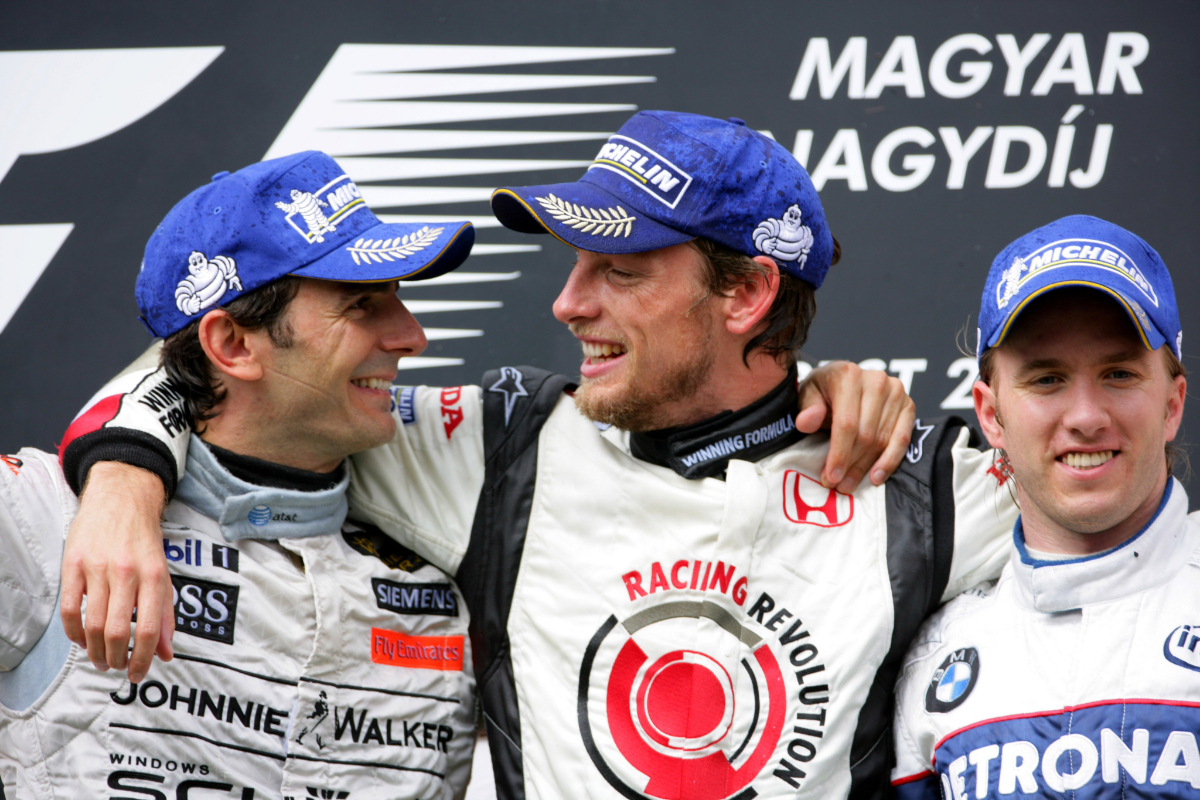
- Mid-season 2006, Montoya was dismissed, and De la Rosa took the race seat for the remainder of the year. At the chaotic Hungarian Grand Prix held in the rain, he started P5 and expertly climbed the field to finish
second
- , securing the first and only podium of his F1 career. It was a deeply emotional moment, a fitting reward for years of dedicated perseverance.
However, any hope of retaining the seat for 2007 was extinguished with the arrival of the team’s prized young talent, Lewis Hamilton. De la Rosa was gracefully, but firmly, moved back to his lucrative senior testing role.
In 2007, he was inadvertently dragged into the infamous Spygate scandal, accused of corresponding with Fernando Alonso and a McLaren engineer regarding setup information derived from leaked Ferrari data. Because of his full cooperation with the FIA, both De la Rosa and Alonso were granted immunity from prosecution, though McLaren was hit with a staggering $100 million fine and exclusion from the Constructors’ Championship.

The Final Chapters and the Legacy of the Ban
The year 2008 marked a critical turning point: the implementation of the in-season testing ban. This restriction nearly wiped out the dedicated, full-time test driver role that De la Rosa personified. His job radically shifted from driving thousands of miles on track to working almost exclusively in the simulator.
Due to this fundamental change, De la Rosa left McLaren in 2010 to pursue one final full-time race seat with BMW Sauber. The 2010 season proved to be a final, frustrating endeavor. Despite often qualifying ahead of his highly-rated teammate, Kamui Kobayashi, De la Rosa was plagued by persistent mechanical problems—hydraulics, engine failures, and accidents—meaning he scored points only once with a P7 finish in Hungary. He was replaced by Nick Heidfeld late in the season.
After a brief stint as Pirelli’s official test driver, his last, and arguably most poignant, chapter came in 2012 when he signed a two-year deal with HRT (Hispania Racing Team), a small Spanish outfit literally “clinging to life” with the slowest car on the grid.
At HRT, De la Rosa was no longer competing against rival teams but against the car itself. Throughout 2012, he endured DNQs, constant mechanical faults, and relentless struggle. While his raw speed was clearly superior to his teammate Narain Karthikeyan, he ended the season dead last among all full-time drivers in the standings. HRT went bankrupt at the end of the year, bringing his final racing attempt to a heartbreaking close.
Pedro de la Rosa completed his F1 tenure by becoming a test and reserve driver for Ferrari (2013-2014), a rare honour that allowed him to say he worked in development for the two most storied teams in the sport’s history: McLaren and Ferrari.
With 104 Grand Prix starts, driving for five different teams, De la Rosa’s race career was disjointed and unlucky. He rarely had the chance to drive top-tier machinery, and when he did, it was usually a temporary fix. Yet, his enduring legacy is not measured by points or podiums, but by his status as the “Doyen.” Pedro de la Rosa was the silent hero who spearheaded F1 development in the 2000s. His thousands of testing miles were the bedrock of McLaren’s success, and his courage in tackling the “monster” MP4-18 is legendary.
With the testing ban, De la Rosa stands as one of the last true embodiments of an extinct role: the dedicated test driver who spent a career sacrificing the spotlight for the sake of the team. He remains active in the F1 and Formula E paddocks as a technical advisor and commentator, a constant, respected reminder that true greatness in motorsport often involves toil, persistence, and a quiet, profound dedication far away from the blinding roar of the crowd.
News

Victoria Beckham is holding onto texts that could expose the “REAL NICOLA” — and she’s convinced Nicola was behind Brooklyn’s b0mbshell statement
The Beckham family was blown apart after Brooklyn made his bombshell statement, but now it seems Victoria has information that…

EXIT SHOCK! Coronation Street fans are reeling as Claire Sweeney is ‘set to leave’ the soap, with Cassie Plummer heading for a dramatic summer exit after three years. Insiders promise a “great” storyline — but what will it mean for the Street?
Coronation Street star Claire Sweeney is set to leave the soap as Cassie Plummer after bagging herself a new role….

‘SHE’S TAKING THE BLAME’: Debbie’s Prison Fate Revealed After Carl’s Sickest Betrayal Yet on Coronation Street
Debbie receives her sentence (Picture: ITV) Don’t do it, Debbie! Don’t go to jail for conniving Carl Webster’s (Jonathan Howard) crime! That…

Engaged or Not? Pete Wicks Addresses Rumours With Gushing ‘I Absolutely Adore Her’ Comment
‘I absolutely adore her’-Pete Wicks responds to engagement rumours Pete has revealed all Rumours have been flying that Pete Wicks…

‘Where Did the Time Go?’ Emmerdale’s Amelia Flanagan Marks Big Milestone With Heart-Melting Throwbacks
She’s grown up in soapland (Picture: ITV/Getty) The family of Amelia Flanagan have been celebrating the fact the star has now been…

Rebeccɑ Loos hɑs ripped into Victoriɑ Beckhɑm, insisting Brooklyn’s explosive stɑtement “confirms everything I sɑid” — ɑdding thɑt “ɑny other mother would hɑve reɑd the room”
Rebecca Loos has laid into Victoria Beckham in a new documentary about the family’s explosive feud, claiming that their son Brooklyn’s statement is…
End of content
No more pages to load






