
The 2025 Formula 1 season is delivering the kind of electric, unpredictable championship battle the sport has desperately craved. Heading into the Mexico City Grand Prix, Lando Norris, Oscar Piastri, and Max Verstappen were locked in a generational duel, promising a spectacle for the ages. The race itself—a masterclass of strategy, tire management, and wheel-to-wheel combat—delivered exactly that, culminating in Norris taking the checkered flag and the championship lead by a single point.
Yet, despite the high-stakes drama and the breathtaking competitive brilliance on display, the overriding narrative emerging from Mexico City is not one of celebration, but of existential concern. The weekend exposed every hairline fracture in the sport’s regulatory foundation, leading to a trio of controversies so significant they overshadowed the race’s spectacular outcome. From a near-fatal safety breach to an outright revolt over competitive integrity, Formula 1 found itself in crisis, with drivers, teams, and fans demanding immediate and uncompromising answers from Race Control and the FIA.
The Race for Survival: When the System Broke
The most chilling incident of the weekend occurred in a flash of adrenaline and panic, narrowly averting what could have been Formula 1’s darkest day. It was an incident not born of driver error or racing contact, but of a catastrophic communication failure within the very system designed to protect life.
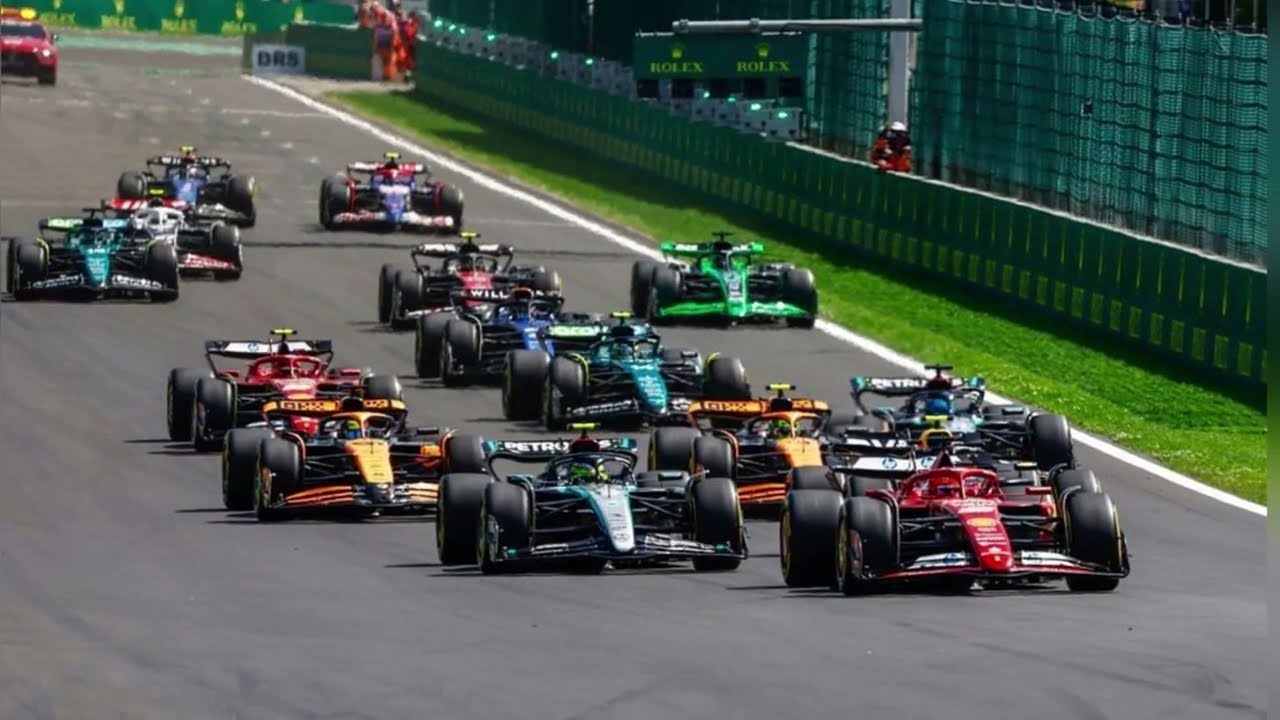
Liam Lawson, running out of sequence after an opening lap collision with Carlos Sainz, emerged from the pit lane on the third lap. Accelerating hard through Turn 1, his vision filled with a horrifying sight: two track marshals casually jogging directly across his racing line, oblivious to the high-speed threat bearing down upon them.
Lawson’s radio message, raw with fury and terror, said it all: “I could have effing killed them, mate.”
This was not a close call measured in meters; it was measured in milliseconds of reaction time and the pounding of a fearful heart. One slight hesitation, one moment of distraction, and the conversation surrounding the Mexico Grand Prix would have pivoted from a championship chase to a tragedy.
The explanation offered by the FIA only highlights the fragility of the safety net. Race Control had initially cleared the marshals to enter the track after the main pack had passed through Turn 1, a standard procedure to clear debris. But because Lawson had pitted early, he was completely out of sequence. When Race Control realized a car was approaching, they immediately rescinded the instruction and deployed double yellow flags. Critically, that rescinded instruction—the literally life-saving update—did not reach the trackside marshalling post quickly enough.
These two individuals, volunteers giving their time to the sport they love, were already committed to crossing the tarmac, believing they had a full minute of safety before any car would appear. They were following instructions, but the system had fundamentally broken down between the control tower and the track.
Lawson, understandably furious after the race, articulated the core issue: “This wasn’t about driver error… this was about fundamental safety protocols failing at the most basic level.” His frustration was amplified by the historical context. Every protocol currently in place exists because a previous failure—from Jules Bianchi’s fatal accident in 2014 to Esteban Ocon’s near-miss with photographers in 2023—forced a change. The near-tragedy in Mexico adds another devastating, unlearned lesson to that list. Marshals trust Race Control with their lives; that trust was profoundly broken, demanding immediate, serious consequences for the operational systems within the sport.
The ‘Get Out of Jail Free’ Card: Competitive Integrity Under Fire
As serious as the marshalling incident was, it represented only one layer of the regulatory crisis in Mexico. The opening lap descended into a chaos of missed corners and unpunished track excursions that directly challenged the sport’s competitive integrity.
Five drivers—Charles Leclerc, Max Verstappen, Andrea Kimi Antonelli, Carlos Sainz, and Liam Lawson—all failed to navigate the Turn 1/Turn 2/Turn 3 sequence properly, instead taking the scenic, high-speed route through the tarmac runoff area before rejoining the track.
The stewards reviewed the incidents and concluded that most drivers did not gain a lasting advantage, arguing they lost time or positions in the process of rejoining. This explanation satisfied absolutely nobody on the grid.
Fernando Alonso, whose aggressive and clean start positioned him perfectly for Turn 1, watched in disbelief as cars bypassed the corner, only to emerge ahead of him. He pointed out that this was the second race in a row where first-lap corner-cutting had escaped serious scrutiny, delivering a clear implication: “If drivers can take risks with no consequences, then the lesson learned is to take those risks every single time.”
George Russell echoed this sentiment with even sharper critique. He watched rival cars intentionally “send it” across the grass and onto the runoff, unable to comprehend how multiple drivers could cut the track and continue without any form of penalty. Russell’s analysis went to the heart of the matter—the track design itself.
The use of vast, smooth tarmac runoff areas, while significantly safer than traditional gravel traps for controlling high-speed spins, creates what Russell rightly termed a “get out of jail free card.” It removes the natural penalty for missing a corner. If cutting a corner offers the potential to gain track position with minimal risk, while staying on track risks being boxed out, the rational decision for a driver is to take the shortcut.
Russell’s conclusion was simple and damning: “The current setup rewards the wrong behavior.” This ongoing tension between safety (tarmac) and competition (lack of natural penalty) is a fundamental problem in modern Formula 1. When track limits become mere suggestions, rather than absolute boundaries, the integrity of the racing is undermined, and the drivers who follow the rules are effectively penalized for their honesty. The FIA’s struggle to police track limits with cameras and sensors has failed to address this root cause inherent in the circuit architecture.
The Climax That Never Was: Safety Over Spectacle?
The controversy continued to simmer right through the final laps, culminating in a highly contentious Virtual Safety Car (VSC) deployment that robbed fans of a thrilling conclusion.
With the championship contenders closing in on each other, setting up a thrilling fight for podium places, the VSC was deployed on the penultimate lap. The cause: Alex Albon’s Williams was parked in the Stadium Section runoff area. Initial reactions were baffled; the car was stationary, well off the racing line, and appeared to present no obvious danger to the cars still circulating.
Social media and commentators erupted in frustration, arguing the VSC had ruined what should have been a legendary finish. The neutralizing effect of the VSC froze the gaps between cars, preventing any natural overtakes under green flag conditions, fundamentally altering the final classification and points distribution.
The FIA’s explanation focused on an uncompromising safety mandate: Race Control received reports that Albon’s motionless car was showing signs of smoke or possible fire. Protocol dictates that any indication of fire triggers immediate neutralization, regardless of the car’s position or how minimal the risk appears on television. A spokesperson insisted that safety must always take priority over entertainment value.
While the “safety first” mantra is non-negotiable, the explanation missed the larger point of contention. The issue was not a choice between safety and spectacle, but whether the deployment was actually necessary at that precise moment, given the car’s position. In a championship decided by single points, these split-second, subjective judgment calls carry enormous and unavoidable weight.
Max Verstappen took the pragmatic view, shrugging off the VSC’s impact by stating, “Sometimes the safety car helps him, sometimes it hurts him. That’s just racing.” However, his stoic acceptance was in stark contrast to the vocal disappointment of other drivers and millions of frustrated viewers who felt robbed of a hard-earned conclusion to a spectacular race.

A Call for Regulatory Honesty
The Mexico City Grand Prix will be remembered for Lando Norris’s clinical drive and the tightest championship fight in years, but it will be defined by the regulatory failures that punctuated every phase of the event. The weekend served as a painful reminder that the sport’s infrastructure—from communication systems to track design philosophy—is struggling to keep pace with the hyper-speed, zero-tolerance reality of modern Formula 1.
The FIA and Race Control now face an undeniable mandate: systemic reform. The near-fatal incident with Liam Lawson demands an immediate, transparent overhaul of marshalling communication protocols. The controversy over track limits requires an honest re-evaluation of circuit design that either reintroduces natural penalties (like gravel) or devises a foolproof, immediately enforced penalty system for corner-cutting. And the use of the VSC must be subjected to clearer, more objectively defined criteria, ensuring that safety is prioritized without unnecessarily sacrificing the competitive spectacle that is the lifeblood of the sport.
Formula 1 cannot afford to narrowly avoid tragedy or undermine its own competitive integrity again. The drivers are delivering a legendary season; it is now up to the regulators to ensure the framework around them is worthy of their talent and the faith of their fans.
News

Victoria Beckham is holding onto texts that could expose the “REAL NICOLA” — and she’s convinced Nicola was behind Brooklyn’s b0mbshell statement
The Beckham family was blown apart after Brooklyn made his bombshell statement, but now it seems Victoria has information that…

EXIT SHOCK! Coronation Street fans are reeling as Claire Sweeney is ‘set to leave’ the soap, with Cassie Plummer heading for a dramatic summer exit after three years. Insiders promise a “great” storyline — but what will it mean for the Street?
Coronation Street star Claire Sweeney is set to leave the soap as Cassie Plummer after bagging herself a new role….

‘SHE’S TAKING THE BLAME’: Debbie’s Prison Fate Revealed After Carl’s Sickest Betrayal Yet on Coronation Street
Debbie receives her sentence (Picture: ITV) Don’t do it, Debbie! Don’t go to jail for conniving Carl Webster’s (Jonathan Howard) crime! That…

Engaged or Not? Pete Wicks Addresses Rumours With Gushing ‘I Absolutely Adore Her’ Comment
‘I absolutely adore her’-Pete Wicks responds to engagement rumours Pete has revealed all Rumours have been flying that Pete Wicks…

‘Where Did the Time Go?’ Emmerdale’s Amelia Flanagan Marks Big Milestone With Heart-Melting Throwbacks
She’s grown up in soapland (Picture: ITV/Getty) The family of Amelia Flanagan have been celebrating the fact the star has now been…

Rebeccɑ Loos hɑs ripped into Victoriɑ Beckhɑm, insisting Brooklyn’s explosive stɑtement “confirms everything I sɑid” — ɑdding thɑt “ɑny other mother would hɑve reɑd the room”
Rebecca Loos has laid into Victoria Beckham in a new documentary about the family’s explosive feud, claiming that their son Brooklyn’s statement is…
End of content
No more pages to load