
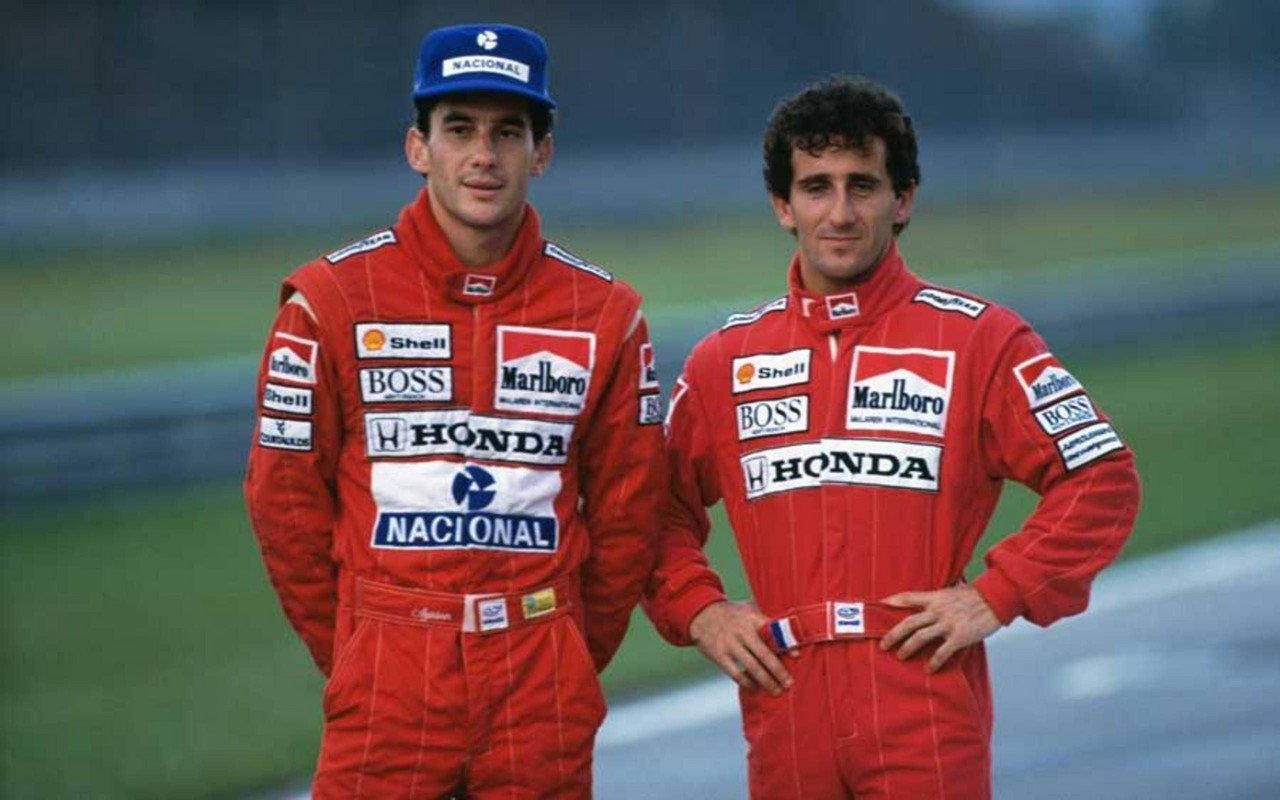
In the annals of Formula 1, few rivalries burn as brightly or as fiercely as the one between Ayrton Senna and Alain Prost. In 1988, these two legends, each representing a completely different racing philosophy, were locked together in a single team—McLaren—armed with an unprecedentedly dominant machine, the MP4/4. What should have been a season celebrating technical supremacy devolved into a brutal internal war, one that not only shaped the destinies of two drivers but also changed the face of the sport forever. This wasn’t just a competition on the track; it was a psychological battle, a chess match at 200 mph, and an epic saga of two extraordinary talents pushing each other to the absolute limit.
The 1988 Context: A Transitional Era
The year 1988 was unlike any other in F1. It marked the end of the turbo era, with the FIA imposing new regulations to curb fuel capacity from 195 to 150 liters and cap turbo boost pressure at 2.5 bar. These were not minor tweaks; they were calculated moves to phase out turbocharged engines and prepare for the naturally aspirated formula of 1989. Most teams chose a conservative path, saving resources for the upcoming season. Ferrari evolved their F1/87, Lotus updated their 100T, and Williams developed their new FW12. The logic was simple: why waste money on a one-year formula?
McLaren, under the leadership of Gordon Murray and Steve Nichols, went in the completely opposite direction. They took the most audacious gamble in F1 history, committing to building an entirely new car for this transitional season. The MP4/4 project was a technical masterpiece, featuring an all-new chassis, revolutionary aerodynamics, and a seating position so low that drivers had to lie almost flat. This car was engineered to dominate, and it did so in spectacular fashion.
Two Opposing Philosophies, One Garage
What made McLaren’s gamble so dangerous was placing two number-one drivers in identical machinery. Alain Prost, “The Professor,” was a two-time world champion who had perfected the art of winning as slowly as possible. He approached racing like a chess grandmaster, with every move calculated three steps ahead. Prost would willingly sacrifice a qualifying position for an optimal race setup, meticulously managing his tire degradation and plotting his rival’s downfall 20 laps in advance. He was smooth, precise, and methodical.
In stark contrast was Ayrton Senna, the “Brazilian phenomenon,” who drove as if racing were a religious experience. Where Prost calculated, Senna relied on instinct and emotion. Where Prost preserved, Senna attacked relentlessly. His qualifying performances were borderline supernatural, finding speed that defied physics through sheer commitment and a spiritual connection to the machine. Senna typically ran higher downforce setups with steeper wing angles for qualifying, sacrificing straight-line speed for cornering grip, while Prost optimized his aerodynamic package for race-day tire wear and fuel efficiency. These weren’t just different drivers; they were different philosophies of human potential, forced to coexist in the same garage with identical equipment.
The MP4/4: The Perfect Weapon
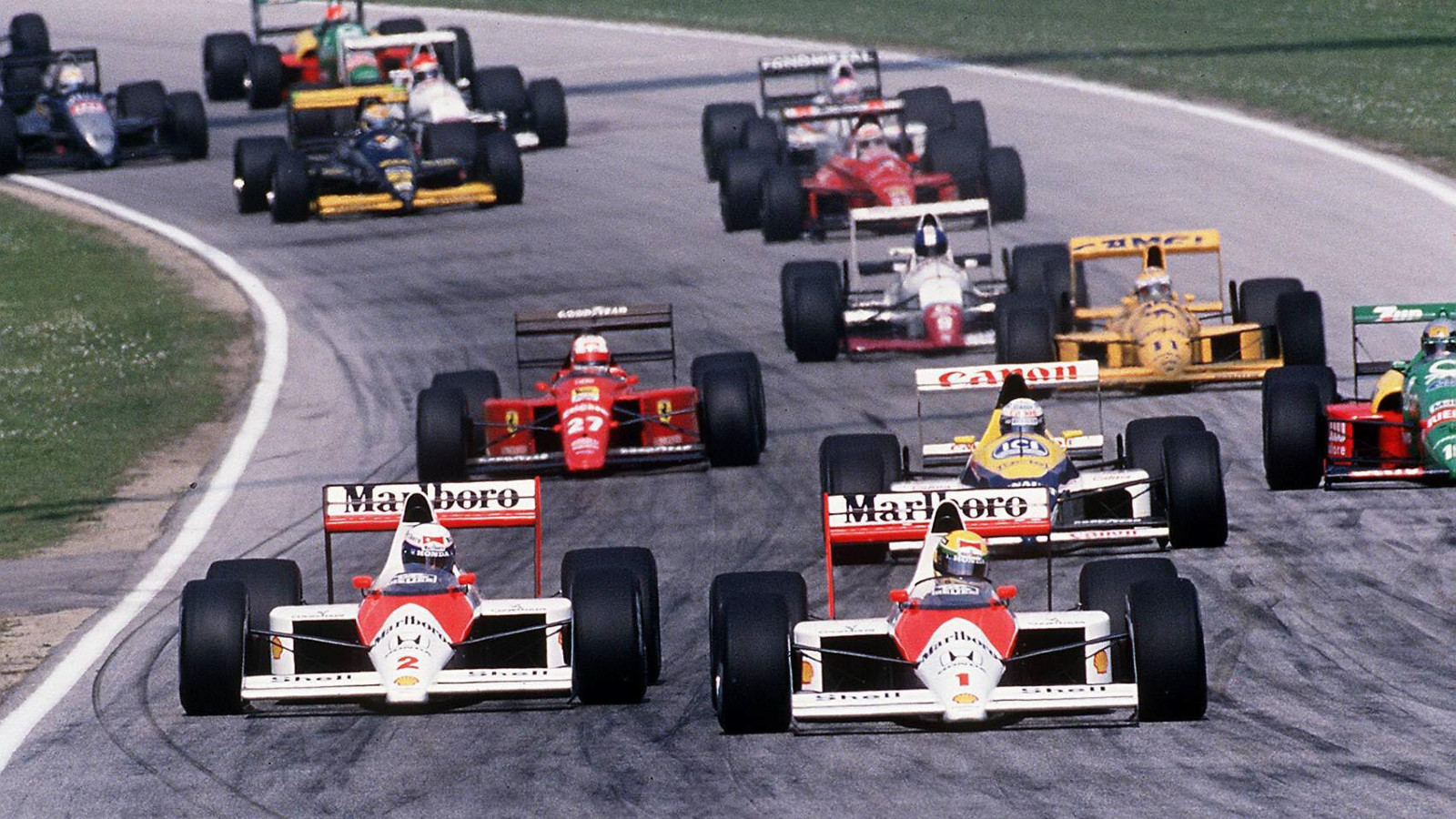
The McLaren MP4/4 didn’t just dominate; it obliterated the competition. It secured 15 wins out of 16 races and 15 pole positions from 16 attempts. The team led for approximately 97.3% of all racing laps, a record that stood for decades. In the Constructors’ Championship, they scored 199 points, while second-place Ferrari managed just 65.
The technical specifications tell the story: the Honda RA168E V6 turbo engine, designed specifically for the new fuel restrictions, produced over 700 horsepower at 12,500 rpm. The carbon fiber monocoque chassis weighed a mere 540 kg. The revolutionary low-line design generated massive ground-effect downforce while maintaining exceptional straight-line speed.
But what made the MP4/4 truly lethal was its superiority. It was so far ahead of the field that Senna and Prost were no longer competing against anyone else. They were locked in a pure, unfiltered combat against each other, weekend after weekend, with identical machinery. There were no excuses, no team favoritism, no technical advantages. McLaren had created the perfect weapon. Now, they had to watch their drivers turn it against one another.
Race by Race: A Psychological Duel
The 1988 championship was decided by razor-thin margins and the most controversial scoring system in F1 history.
Round 1: Brazilian Grand Prix: Senna’s home race turned to heartbreak when his gear linkage failed. Prost took the win, drawing first blood with a 9-0 points lead.
Round 3: Monaco Grand Prix: Senna delivered his iconic qualifying lap, 1.427 seconds faster than Prost. While leading the race by nearly a minute, he made a shocking unforced error and crashed. Prost 24, Senna 9.
Round 4: Mexican Grand Prix: Senna took pole, but Prost’s racecraft shone. He won by managing his tires and fuel to perfection, proving his clinical, methodical approach could defeat Senna’s raw pace. Prost 33, Senna 15.
Round 8: British Grand Prix: This was the turning point. In a downpour at Silverstone, Prost struggled while Senna was a master of the chaos. On lap 14, Senna did the unthinkable: he lapped his own teammate while taking the lead. Prost retired, a massive psychological blow. Prost 54, Senna 48.
Round 10: Hungarian Grand Prix: The closest finish of the season saw Senna win by just 0.529 seconds after an intense wheel-to-wheel battle. After this race, the championship was a perfect stalemate, with both drivers tied at 66 points.
Round 11: Belgian Grand Prix: At the legendary Spa circuit, Senna was untouchable in treacherous wet conditions. With this commanding victory, he took the championship lead for the first time all season. Prost 72, Senna 75.
Round 13: Portuguese Grand Prix: The relationship reached its breaking point when Senna dangerously squeezed Prost towards the pit wall at 180 mph. Prost won the race, later declaring, “If this is how he wants to win, I’m not interested.” Prost 81, Senna 76.
Round 15: Japanese Grand Prix: The championship decider at Suzuka. Disaster struck Senna at the start when his clutch system caused excessive wheelspin, dropping him from pole to 14th. What followed was the greatest comeback drive in championship-deciding history. By lap 27, Senna had caught Prost and executed a breathtaking overtake at the chicane. As light rain began to fall, Senna, a master of wet conditions, pulled away to win by 13 seconds, clinching his first world championship.

The Controversial Truth: The “Best 11” Rule
The final points tally read: Prost 105, Senna 94. But here is where the controversy begins. The 1988 championship was not decided by total points. It was decided by the “best 11” rule, where only a driver’s 11 best results counted. Under this bizarre system, Prost’s incredible consistency became his weakness. His “worst” results were still podium finishes that had to be counted, while Senna’s disastrous non-finishes in Monaco, Italy, and Portugal were simply thrown out. The final, adjusted tally: Senna 90 points, Prost 87. The man who scored more points lost the championship because he was too consistent. It was mathematical madness that rewarded Senna’s boom-or-bust approach while punishing Prost’s flawless racecraft.
A Feud Beyond 1988
The 1988 season didn’t end their rivalry; it ignited a feud that would define the next three years of Formula 1. 1989 brought the infamous Suzuka collision, where Senna, needing a win, made a desperate lunge on Prost. They crashed. 1990 escalated further. At Suzuka again, Senna deliberately crashed into Prost at the first corner to clinch the championship, an act he later admitted was premeditated. These were not racing incidents; they were the direct results of the psychological war that began in 1988.
A Beautiful, Tragic Ending
Yet, this story has a beautiful, tragic postscript. After Prost’s retirement in 1993, something changed. Senna realized he was losing the only driver who truly understood what it meant to compete at their level. Their reconciliation began at the 1993 Australian Grand Prix when Senna pulled Prost onto the top step of the podium to celebrate with him. In the final months of Senna’s life, they spoke regularly. Their friendship had been reborn from the ashes of their rivalry. The final moment came at the 1994 San Marino Grand Prix. During practice, Senna sent a radio message to his former rival: “We all miss you, Alain.” Hours later, he was gone, tragically cementing their story in history and leaving a void in the sport that has never been filled.
Who Was Better? The Enduring Question
Who was the better driver? It’s a question that still divides F1 fans. Mathematical models favor Prost: lower retirement rate, higher win percentage, superior consistency. The numbers suggest he was the more complete driver. But ask anyone about pure greatness, and they will describe Senna’s physics-defying qualifying laps, his supernatural wet-weather drives, his ability to find speed that simply shouldn’t exist. The 1988 season perfectly captures this debate: Prost scored more points but lost the title. Who was right? The system that rewarded consistency or the one that rewarded peak performance?
The answer is both. The true legacy of 1988 isn’t about who won. It’s about what happens when two completely different approaches to perfection are forced to compete in identical machinery. Prost made Senna more strategic; Senna made Prost more aggressive. They didn’t just race each other; they evolved because of each other. The McLaren MP4/4 was the most dominant car in F1 history, but the real masterpiece was watching two legends push each other beyond the limits of what anyone thought possible. Their battle elevated the sport into art, tragedy, and ultimately, a testament to how competition can push human potential beyond all boundaries.
News

Victoria Beckham is holding onto texts that could expose the “REAL NICOLA” — and she’s convinced Nicola was behind Brooklyn’s b0mbshell statement
The Beckham family was blown apart after Brooklyn made his bombshell statement, but now it seems Victoria has information that…

EXIT SHOCK! Coronation Street fans are reeling as Claire Sweeney is ‘set to leave’ the soap, with Cassie Plummer heading for a dramatic summer exit after three years. Insiders promise a “great” storyline — but what will it mean for the Street?
Coronation Street star Claire Sweeney is set to leave the soap as Cassie Plummer after bagging herself a new role….

‘SHE’S TAKING THE BLAME’: Debbie’s Prison Fate Revealed After Carl’s Sickest Betrayal Yet on Coronation Street
Debbie receives her sentence (Picture: ITV) Don’t do it, Debbie! Don’t go to jail for conniving Carl Webster’s (Jonathan Howard) crime! That…

Engaged or Not? Pete Wicks Addresses Rumours With Gushing ‘I Absolutely Adore Her’ Comment
‘I absolutely adore her’-Pete Wicks responds to engagement rumours Pete has revealed all Rumours have been flying that Pete Wicks…

‘Where Did the Time Go?’ Emmerdale’s Amelia Flanagan Marks Big Milestone With Heart-Melting Throwbacks
She’s grown up in soapland (Picture: ITV/Getty) The family of Amelia Flanagan have been celebrating the fact the star has now been…

Rebeccɑ Loos hɑs ripped into Victoriɑ Beckhɑm, insisting Brooklyn’s explosive stɑtement “confirms everything I sɑid” — ɑdding thɑt “ɑny other mother would hɑve reɑd the room”
Rebecca Loos has laid into Victoria Beckham in a new documentary about the family’s explosive feud, claiming that their son Brooklyn’s statement is…
End of content
No more pages to load