
In the rarefied air of Formula 1, the winner’s circle is a notoriously closed club. It is a sport of legacy, of hundred-year-old brands and billion-dollar dynasties. Newcomers are rare, and successful ones are almost mythical. The last time a new team joined the grid was in 2016 with Haas, an entry that, while resilient, has largely defined the modern “back-marker” role. They entered with a pragmatic, cost-effective model, buying as many parts from Ferrari as the rules would allow.
It is with this backdrop of expectation—or lack thereof—that Cadillac is assembling its 2026 entry. And if you think you know how this story goes, you are almost certainly wrong.
Cadillac is not just joining the grid; it is planning an ambush. Leveraging the 2026 regulation reset, which will see all-new cars and engines, the American automotive giant is meticulously building a war machine. They are not following the Haas model. They are not aiming for survival. They are aiming for a shock, and they are putting the budget, talent, and strategic planning in place to pull it off.
This isn’t a hopeful dream; it’s a calculated assault on the midfield. And it starts with the single most important statement a new team can make: its drivers.

The ‘Experience-First’ Coup
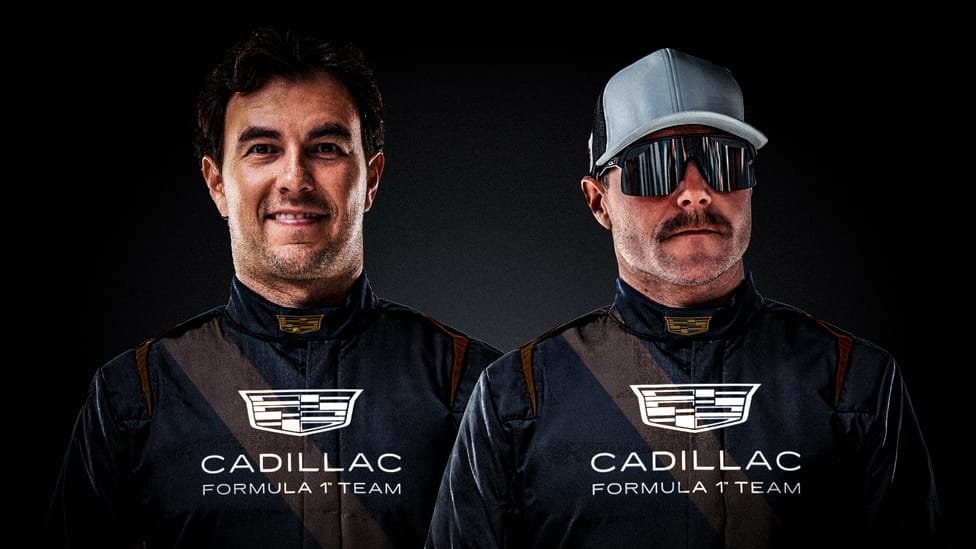
Forget the common new-team playbook of hiring one veteran and one “pay driver” to fund the operation. Cadillac has thrown that script into the shredder. Instead, they have signed one of the most experienced, proven, and professional duos available: Sergio “Checo” Perez and Valtteri Bottas.
This is not a lineup for building a team over five years. This is a lineup for scoring points in race one.
Let’s break down this statement of intent. In Sergio Perez, they acquire a recent race winner fresh from the most dominant team on the modern grid, Red Bull Racing. While his final stint there may have been challenging, Perez brings something invaluable: the DNA of a championship-winning operation. He knows what it takes to fight at the front, how a top-tier team responds to pressure, and possesses a legendary race craft. He is not a driver looking for a quiet retirement; he is a driver with a point to prove.
In his garage counterpart, Valtteri Bottas, Cadillac secures the ultimate professional. Forged in the crucible of the Mercedes dynasty alongside Lewis Hamilton, Bottas is a 10-time Grand Prix winner. He’s a “sleek professional,” a qualifying powerhouse, and a man who has lived and breathed the relentless pressure of a team winning eight consecutive championships. He understands the corporate structure, the engineering feedback, and the sheer consistency required to build a powerhouse.
Together, this duo represents a staggering wealth of knowledge from the two most successful teams of the last 15 years. Cadillac isn’t just buying their speed; it’s buying their intelligence. It’s an immediate infusion of elite experience, a signal to the paddock that they are not here to make up the numbers. They are here to fight, and they’ve hired two of the grid’s most seasoned brawlers to lead the charge.
Building a Super Team from Zero
A new Formula 1 team is one of the most complex startup operations on Earth. Cadillac’s approach can be summed up in one word: aggressive.
While the team was born from the long-running Andretti bid, its current form, backed by General Motors, is a different beast entirely. They are on an unprecedented hiring spree, a “war for talent” that has seen them poach key figures from established teams. The organization has already swelled from zero to over 400 employees, with a clear target of 600 to 650 personnel by the time the cars hit the track for the 2026 Australian Grand Prix.
This is not a small, lean operation. This is a team being built to the scale of a McLaren or an Aston Martin, right out of the box.
To house this army, Cadillac is establishing a global footprint, a clear sign of its long-term, multi-national commitment. This isn’t a single factory in a windswept English industrial park. They are leveraging three distinct, high-tech facilities: a headquarters in Charlotte for simulation, a dedicated aerodynamics base in Silverstone (the heart of F1’s “Motorsport Valley”), and a construction and operations hub in Fischers, Indiana.
This infrastructure is the bedrock of their ambition, a billion-dollar foundation designed to compete on a global stage. They’ve even brought in leadership, like ex-Marushia CEO Loen, who has seen the pitfalls of starting an F1 team from scratch and knows precisely what failures to avoid.
The Secret Weapon: Practicing for a Race That Hasn’t Happened
Perhaps the most shocking part of Cadillac’s preparation is what’s happening behind closed doors, right now. They are practicing for the 2026 season with a car that doesn’t even exist yet.
Thanks to their status as a new entrant, Cadillac was granted a crucial head start, gaining access to 2026 car development two to three months earlier than their competitors. They have not wasted a single day.
The team is already running full-scale race simulations. This is not just a driver in a sim. This is a “mission control” of 60 engineers, glued to their screens, simulating an entire race weekend—from the first practice session on Friday to the checkered flag on Sunday. They are running strategies, testing basic setups, and, most importantly, practicing for failure. They are intentionally throwing “malfunctions” and “errors” into the system to stress-test their communications and protocols.
As team consultant Pat Simmons has noted, the goal is to “calibrate everything without having a real car yet.”
Think about that. Before a single piece of carbon fiber has been laid for their chassis, Cadillac’s race team is already learning how to work together under pressure. They are building the human network, the communication, and the muscle memory that wins (or loses) races. They are even running a full pit crew, practicing tire changes on a mule car built to the 2026 specifications.
This is an unprecedented level of preparation. It’s a meticulous, driven approach designed to eliminate the “rookie mistakes” that plague new teams. By the time their car finally rolls out of the garage, the team behind it will have already contested a dozen virtual seasons.
The Ultimate Gamble: The Ferrari “Non-Partnership”
Here is where Cadillac’s strategy becomes truly audacious. It would have been easy, and perhaps even sensible, to follow the Haas model: buy an engine, a gearbox, suspension, and as many other “non-listed parts” as possible from a partner like Ferrari.
Cadillac has chosen the hard way.
The team has secured a deal for a 2026-spec Ferrari power unit and gearbox—a proven, powerful core. But they have explicitly refused to purchase other components, most notably the suspension. This is a massive gamble. Building your own suspension is infinitely more complex and expensive.
So why do it? Because it “uncaps” their potential.
By designing their own suspension and other key parts, Cadillac is not locked into Ferrari’s design philosophy. They can build a car that is truly theirs, with an aerodynamic concept that is not compromised by “off-the-shelf” parts from another team. It allows their technical team to be creative and aggressive. This is the fundamental difference between a “customer team,” forever doomed to be one step behind its supplier, and a true “constructor” capable of one day fighting for wins.
It’s a decision that signals they are willing to endure short-term pain for long-term gain. To help their drivers get up to speed, Perez is scheduled to run a private test in a 2023 Ferrari, but this is less about development and more about physical re-acclimatization—getting his “neck and G-forces” ready for the demands of F1.

The 2026 Shockwave
Cadillac has already passed its first mandatory FIA crash tests, a key hurdle. The first engine fire-up is scheduled for December 2025. The pieces are moving into place, with a speed and precision that is rattling the paddock.
Let’s be clear: Cadillac will not win the 2026 World Championship. That would be an insane, impossible shock. But that is not the benchmark for success.
The expectation for a new team is to be a back-marker. The expectation is to be slow, to make mistakes, to be lapped. Cadillac, with its top-tier driver pairing, its massive investment in talent, its advanced simulation program, and its high-risk, high-reward design gambit, is positioned to shatter those expectations.
If this team is fighting in the midfield in 2026, it will be a monumental achievement. If they are scoring points consistently, it will be a coup.
This is not the hopeful entry of a plucky underdog. This is the calculated arrival of a giant. Cadillac isn’t just building a car; it’s building a warning. And in 2026, the rest of the grid is going to hear it.
News

Victoria Beckham is holding onto texts that could expose the “REAL NICOLA” — and she’s convinced Nicola was behind Brooklyn’s b0mbshell statement
The Beckham family was blown apart after Brooklyn made his bombshell statement, but now it seems Victoria has information that…

EXIT SHOCK! Coronation Street fans are reeling as Claire Sweeney is ‘set to leave’ the soap, with Cassie Plummer heading for a dramatic summer exit after three years. Insiders promise a “great” storyline — but what will it mean for the Street?
Coronation Street star Claire Sweeney is set to leave the soap as Cassie Plummer after bagging herself a new role….
‘SHE’S TAKING THE BLAME’: Debbie’s Prison Fate Revealed After Carl’s Sickest Betrayal Yet on Coronation Street
Debbie receives her sentence (Picture: ITV) Don’t do it, Debbie! Don’t go to jail for conniving Carl Webster’s (Jonathan Howard) crime! That…

Engaged or Not? Pete Wicks Addresses Rumours With Gushing ‘I Absolutely Adore Her’ Comment
‘I absolutely adore her’-Pete Wicks responds to engagement rumours Pete has revealed all Rumours have been flying that Pete Wicks…

‘Where Did the Time Go?’ Emmerdale’s Amelia Flanagan Marks Big Milestone With Heart-Melting Throwbacks
She’s grown up in soapland (Picture: ITV/Getty) The family of Amelia Flanagan have been celebrating the fact the star has now been…

Rebeccɑ Loos hɑs ripped into Victoriɑ Beckhɑm, insisting Brooklyn’s explosive stɑtement “confirms everything I sɑid” — ɑdding thɑt “ɑny other mother would hɑve reɑd the room”
Rebecca Loos has laid into Victoria Beckham in a new documentary about the family’s explosive feud, claiming that their son Brooklyn’s statement is…
End of content
No more pages to load