
The second practice session of the Grand Prix weekend was never going to be a routine affair. Under the glare of the artificial lights, and on a circuit notorious for its technical demands and unforgiving walls, every team was operating at the razor’s edge. Yet, what unfolded in the pit lane—an area historically viewed as a controlled sanctuary—was an “operational collapse” that has sent a chilling warning across the entire Formula 1 paddock. The collision between Charles Leclerc’s Ferrari and Lando Norris’s McLaren was not simply an unfortunate racing incident; it was, as the subsequent FIA verdict implied, a structural failure born of intolerable pressure and a dangerous disconnect between technological sophistication and human craft.
The incident was the direct consequence of a chaotic environment. An earlier red flag, caused by a driver losing control of their car, had drastically reduced effective track time. Teams, already running demanding test programs, were gripped by a fierce urgency to maximize every remaining second. This necessity created an operational bottleneck inside the pit lane, transforming the normally methodical process of car release into a frantic, high-stakes game of chance. Engineers, mechanics, and drivers found themselves working under almost unbearable tension—a desperate, counter-clockwise race to execute outputs without error margin. It was precisely this need to operate at the absolute limit that lit the fuse for the explosive encounter.
The Anatomy of the Collision: A Split-Second Error
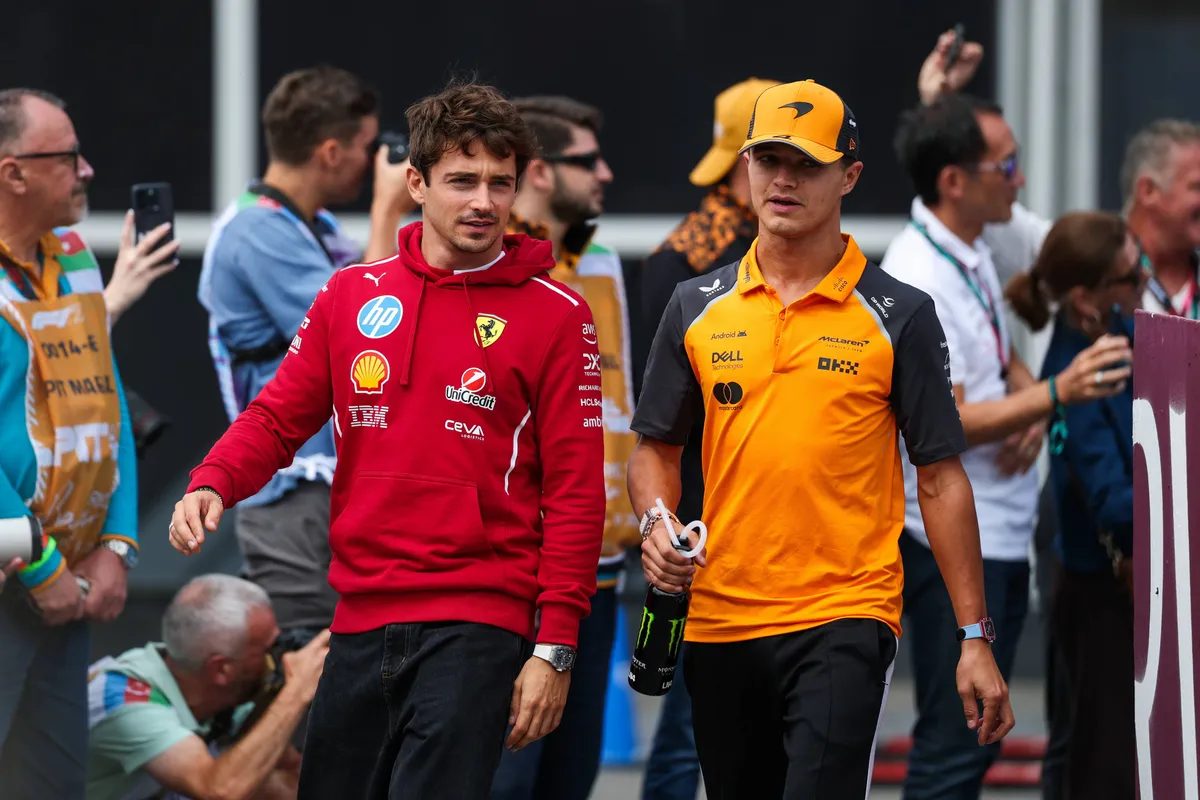
The drama unfolded as Race Control announced the resumption of the session. Ferrari and McLaren, situated in consecutive boxes, prepared to launch their cars almost simultaneously. McLaren released Lando Norris first, sending the British driver into the fast lane of the pit. Just moments later, Ferrari authorized the departure of Charles Leclerc. What followed was a synchronization error in its purest, and most dangerous, state.
Leclerc, trusting the signal given by his mechanic, began to move out just as Norris was speeding past. The onboard camera footage from the Ferrari later showed that the lateral visibility for the Monégasque pilot was practically zero. This crucial detail underscores a fatal operational dependency: Leclerc had no way to visually verify the fast lane was clear, forcing him to rely entirely on the guidance of his pit crew.
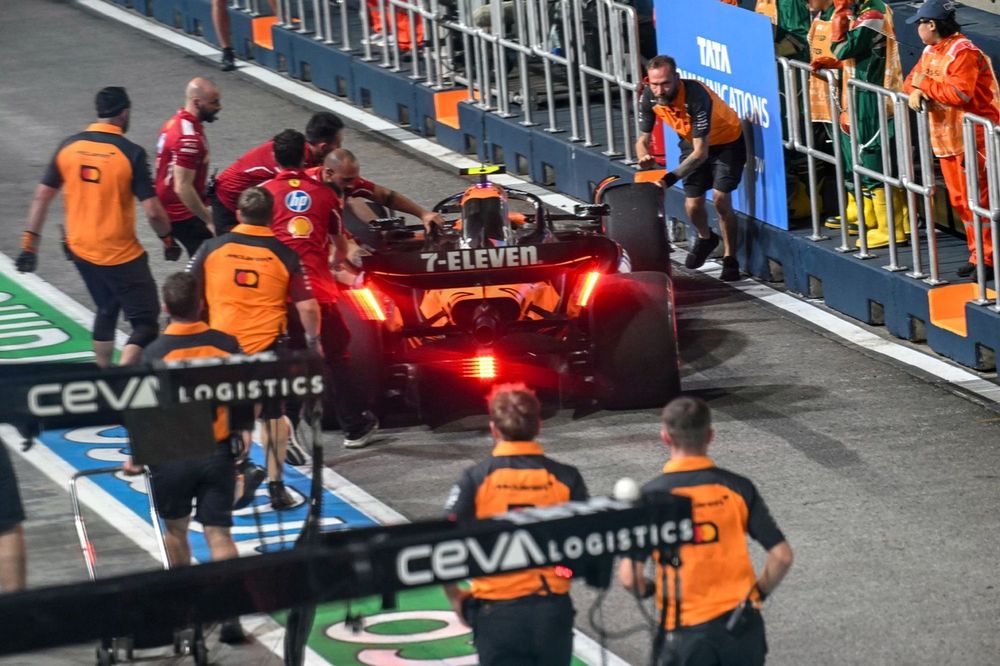
The impact was inevitable and jarring. The Ferrari struck the left front wheel of the McLaren with enough force to violently shunt Norris against the inner wall of the pit lane. The front wing of the papaya car was instantly reduced to wreckage, forcing McLaren to overhaul their test program and face unscheduled repairs. While Leclerc appeared to continue without major damage, the incident had already been flagged for an official FIA investigation, immediately transforming a moment of tension into a question of regulatory failure.
This was more than a simple accident. It was the convergence of a “perfect storm of sports pressure, failures in internal communication, limited visibility, and critical time management.” The televised scene vividly exposed a vulnerability in current F1 procedures, asking a critical question: how prepared is the equipment to operate safely under high demand when the margin between a brilliant decision and a catastrophe is measured in milliseconds?
The Damning Verdict: Negligence, Not Accident
The response from the FIA arrived swiftly. The governing body faced a delicate situation, not only due to the obvious damage inflicted on Norris’s car but because of the precedent such a case would set in an environment where pit lane security is a growing issue. Historically, the pit lane has been treated as a controlled, safe area, but this episode definitively confirmed its susceptibility to chaos.
Leclerc and Ferrari representatives were officially summoned before the sports commissioners. The investigation was meticulous, utilizing technical tests, onboard camera recordings, closed-circuit footage of the pit lane, and circuit staff reports. Yet, the true determining factor in the verdict was the sequence of decisions taken by the Italian team moments before the impact.
The official document issued by the commissioners was unequivocal. It stated that the Leclerc car was authorized to exit by a member of the Ferrari team who “failed to perform a complete evaluation of the pit lane situation.” Norris’s car was already circulating through the rapid lane, having been released by McLaren moments earlier. The commissioners emphasized that the exit order was neither clear nor safe. Critically, they absolved the driver: the Ferrari pilot had no realistic way of perceiving the McLaren’s approach from his limited visibility position.
The verdict made it clear: “The error was not from Leclerc as an individual. It was the Ferrari operating system.” Responsibility rested squarely on the shoulders of the individual in charge of coordinating the car’s release under maximum tension. This was not merely a simple technical infraction; it was a “lack of diligence” in the operation of the pit lane, an area demanding absolute control by the team. The trial underscored that, in these scenarios, responsibility cannot be delegated to the driver when the error is systemic, and therefore, the sanction must be “exemplary.”

The Symbolic Power of the €10,000 Fine
The sanction imposed on Ferrari was a fine of €10,000. While this figure may seem negligible within the multi-million dollar budgets of a top-tier F1 team, the true weight of the punishment lies not in the amount, but in the message it carried.
In their statement, the FIA was unusually explicit, pointing out that incidents of this type had been treated with “indulgence in the past,” but that the current verdict now imposed a “higher rod.” The commissioner’s official comment that this infraction deserved “a more severe punishment than usual” is what truly marks this as a turning point. We are witnessing a clear hardening in the sanction criteria related to operational safety.
This is a warning shot to the entire grid: the obsession with optimizing every millisecond cannot be allowed to compromise security, especially not in the volatile pit lane where cars, mechanics, cameras, journalists, and race officers all converge. This decision initiates a new chapter in FIA risk management, moving away from a purely punitive logic—sanctioning only the damage caused—and towards a preventive vision focused on potential risk and operational negligence. The sanction punishes not only the resulting impact but the procedural failure that made it possible. In a championship as tightly contested as modern Formula 1, where margins are microscopic, a sanction of this type, even without directly subtracting points, can have a devastating collateral effect on a team’s morale and operational discipline.
Leclerc: The Pilot as ‘Passenger’ in the Pit Lane
In the aftermath of the verdict, Charles Leclerc, the visible face of the incident, went public with statements that shed critical light on the reality of a modern F1 driver’s role in the pit lane. Far from being evasive, Leclerc painted a picture of the pilot as an almost passive “passenger” in this controlled environment.
He spoke candidly about the confusion with the cars preparing to leave and the assumption by his chief mechanic that Norris’s car would slow down—an assumption that led to the green light for the Ferrari without anticipating the danger. Crucially, Leclerc explained that he did not receive a clear indication to stop. In the confines of the pit lane, where lateral visibility is extremely reduced and rearview mirrors are virtually useless for such close movements, the driver must, by necessity, place absolute trust in the team’s call.
Leclerc’s defense was more than a self-vindication; it was a pointed critique of the operational structure that leaves the driver exposed and stripped of the tools needed to make a final safety decision. His argument moves beyond the specific collision, redefining how security is understood in areas where the focus has, until now, been weighted more towards logistics and speed than the palpable risk to human life.
The F1 Anachronism: Technology vs. The Human Eye
The collision during the practice session should not be dismissed as a simple logistics error or an isolated event. It is, in essence, a critical warning signal for the entire Formula 1 ecosystem—a raw reminder that, even in a sport obsessed with millimeter perfection and data, there remain dangerous gray areas where human improvisation, pressure, and error still hold sway. The pit lane is now definitively claiming urgent attention.
Formula 1 has evolved at a dizzying technological pace. Current monoposts are equipped with sophisticated telemetry, predictive reliability alerts, track traffic detection, and absolute control over every performance parameter. Yet, when the moment comes to release a car from the box, the first and last line of defense often remains a mechanic watching with their naked eye whether another car is approaching. This dichotomy—the stark disconnection between technological sophistication on the track and the “craft” in the boxes—is an anachronism that can no longer be tolerated.
The FIA’s more severe sanction for Ferrari’s unsafe release is a clear message to the entire grid: “The old habits no longer take place in Formula 1.” Teams must immediately review, update, and professionalize their output procedures. The bridge between the cutting-edge technology that governs performance and the dangerously manual, human-dependent system that governs safety must be closed. The safety of drivers like Charles Leclerc and Lando Norris, and indeed the entire pit crew, demands that operational protocols be elevated to the same standard of perfection as the engineering that powers the cars they race. The €10,000 fine is a mere footnote; the real story is the non-negotiable shift in F1’s commitment to safety enforcement.
News

Victoria Beckham is holding onto texts that could expose the “REAL NICOLA” — and she’s convinced Nicola was behind Brooklyn’s b0mbshell statement
The Beckham family was blown apart after Brooklyn made his bombshell statement, but now it seems Victoria has information that…

EXIT SHOCK! Coronation Street fans are reeling as Claire Sweeney is ‘set to leave’ the soap, with Cassie Plummer heading for a dramatic summer exit after three years. Insiders promise a “great” storyline — but what will it mean for the Street?
Coronation Street star Claire Sweeney is set to leave the soap as Cassie Plummer after bagging herself a new role….

‘SHE’S TAKING THE BLAME’: Debbie’s Prison Fate Revealed After Carl’s Sickest Betrayal Yet on Coronation Street
Debbie receives her sentence (Picture: ITV) Don’t do it, Debbie! Don’t go to jail for conniving Carl Webster’s (Jonathan Howard) crime! That…

Engaged or Not? Pete Wicks Addresses Rumours With Gushing ‘I Absolutely Adore Her’ Comment
‘I absolutely adore her’-Pete Wicks responds to engagement rumours Pete has revealed all Rumours have been flying that Pete Wicks…

‘Where Did the Time Go?’ Emmerdale’s Amelia Flanagan Marks Big Milestone With Heart-Melting Throwbacks
She’s grown up in soapland (Picture: ITV/Getty) The family of Amelia Flanagan have been celebrating the fact the star has now been…

Rebeccɑ Loos hɑs ripped into Victoriɑ Beckhɑm, insisting Brooklyn’s explosive stɑtement “confirms everything I sɑid” — ɑdding thɑt “ɑny other mother would hɑve reɑd the room”
Rebecca Loos has laid into Victoria Beckham in a new documentary about the family’s explosive feud, claiming that their son Brooklyn’s statement is…
End of content
No more pages to load