
Imagine a driver so singularly focused on victory that he is described as “perfection determined.” A champion so ruthless that his rivals genuinely feared racing wheel-to-wheel with him, unsure if he would leave them space… or simply drive them off the road. A legend so relentless that he redefined the very meaning of greatness in his sport.
That man was Michael Schumacher.
Seven world titles. 91 race wins. 68 pole positions. A man who took a fallen giant, Ferrari, and single-handedly built it into an indomitable empire. Yet, for all his brilliance, his greatest moments were often shadowed by dark, polarizing controversy. He was a hero to millions and a villain to countless others.
Today, more than a decade after a tragic skiing accident removed him from public life, his shadow looms larger than ever over Formula 1. But it’s a shadow that highlights a stark new reality: drivers like Michael Schumacher don’t exist anymore. They are extinct. The sport of Formula 1, whether by design or evolution, has changed. The rules have changed, the culture has changed, and the very concept of a “ruthless” champion has been erased.
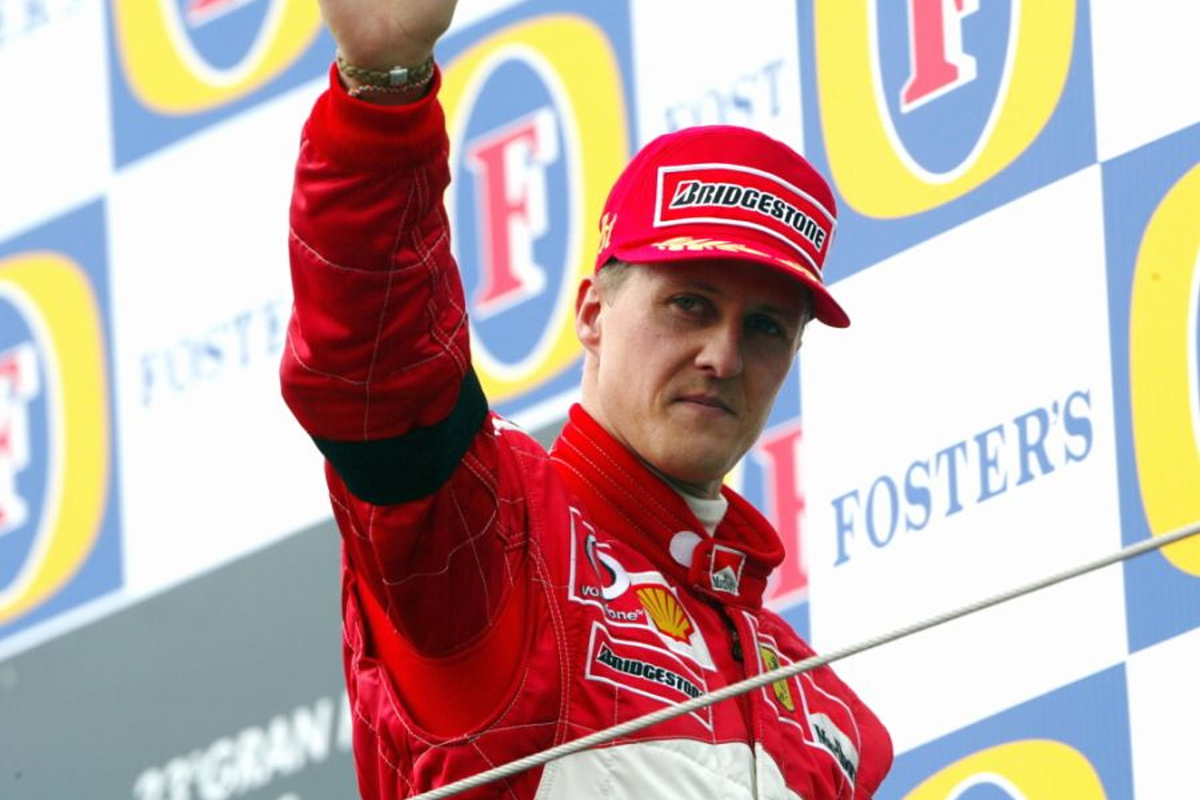
To understand why this breed has vanished, you must first understand the man who perfected it.
Michael Schumacher was not born into the glamorous, moneyed world of motorsport. Born in 1969, his father, Rolf, was a bricklayer who managed the local karting track in Kerpen, West Germany. His mother, Elisabeth, ran the canteen. Money was perpetually tight. But what the Schumachers lacked in wealth, they had in access. At just four years old, young Michael was driving a pedal kart fitted with a small motorcycle engine. By six, he was a local champion.
This wasn’t a hobby; it was a forging. While other kids played, Michael was learning. He wasn’t just quick; he was relentless. He studied corners, meticulously analyzed his opponents, and cultivated an iron-clad refusal to accept second best. This fire took him to the 1987 European Karting Championship, and by 1990, he stunned the racing world by winning not only the German F3 title but also the legendary Macau Grand Prix, one of the toughest proving grounds for young talent.
In 1991, his break came. Jordan needed a last-minute replacement for the Belgian Grand Prix. Schumacher, who had famously never driven the daunting Spa track, qualified an outrageous seventh in an uncompetitive car. The paddock was electrified. He didn’t even finish the race—his clutch failed—but it didn’t matter. Flavio Briatore of Benetton signed him immediately.
A year later, at that same Spa circuit, he won his first Grand Prix. By 1994, he was a World Champion, though his first title would forever be stained. In the final race at Adelaide, he collided with his sole title rival, Damon Hill, taking both of them out and securing the championship for himself. Was it a racing incident or a deliberate act of sabotage? The debate rages to this day. In 1995, he answered the doubters with a second, dominant title. He was on top of the world.
And then, he did the unthinkable. In 1996, he left the championship-winning Benetton team for Ferrari.
At the time, this was seen as career suicide. Ferrari was a mess, a sleeping giant lost in a bureaucratic nightmare. The legendary Italian team hadn’t won a driver’s championship since 1979. But Michael wasn’t just looking for more wins; he was looking for a legacy.
What followed was a display of sheer, unadulterated willpower. The 1996 Ferrari was, to put it kindly, unworthy. But Schumacher dragged it to results it had no business achieving. His drive in the torrential rain of the 1996 Spanish Grand Prix—where he won by 45 seconds—is still considered one of the greatest performances in F1 history, earning him the nickname “the Rainmaster.”
Off the track, his work ethic was merciless. He trained harder, spent more time in the gym, and lived at the Ferrari factory in Maranello. He pushed engineers, analyzed data for days on end, and demanded more from everyone, and even more from himself. Teammates described him as both inspiring and utterly suffocating. He wasn’t just a driver; he was a leader, a tyrant, and a visionary, molding the entire team into an extension of his own will.
After years of heartbreak, the breakthrough came in 2000. Under immense pressure at Suzuka, he held off his great rival Mika Häkkinen to clinch Ferrari’s first driver’s title in 21 agonizing years. The tears on the podium were for a nation, a team, and a promise fulfilled.
That victory didn’t just open the floodgates; it unleashed a tidal wave. From 2000 to 2004, Schumacher and Ferrari were untouchable. He secured his fifth title in 2002 with six races still to go, the earliest win in history. The 2004 season was his crowning glory: 13 wins from 18 races, a year so dominant it left rivals “not just beaten, but obliterated.” The red Ferrari wasn’t just a car; it was a weapon, and rivals dreaded seeing it in their mirrors.

But this total dominance came at a price. This is what made Schumacher different. It wasn’t just that he won; it was how he won.
If there was a gap, he took it. If there wasn’t, he forced one. The 1994 Adelaide incident was just the beginning. In 1997, during another title-deciding finale in Jerez, he infamously turned in on his rival, Jacques Villeneuve, in a blatant attempt to take him out. This time, it backfired. Schumacher was out, Villeneuve continued, and Michael was disqualified from the entire championship for his unsportsmanlike conduct. Then came Monaco 2006, where he faked a crash in the dying seconds of qualifying, “parking” his car to block the track and prevent his rival Fernando Alonso from taking pole position.
Was he a genius exploiting every possible edge? Or was he a cheater willing to cross any line for victory? The answer, frustratingly, is that he was both. And that is precisely what F1 has lost.
When he first retired in 2006, his records seemed untouchable. His return with Mercedes in 2010 was a surprise. He was 41, and he wasn’t the same driver. He didn’t win a race. But his new role was just as critical: he mentored Nico Rosberg and laid the foundational groundwork for the Mercedes dynasty that would soon dominate the sport. His stunning pole position lap at Monaco in 2012 was a final, brilliant flash—a reminder that the speed was, and always would be, there.
His final retirement in 2012 seemed to close the chapter. Then, on December 29, 2013, the world froze. While skiing off-piste with his son, Michael fell and hit a rock, suffering a traumatic brain injury. The man who had survived decades at 200 mph was felled by a freak accident on snow.
After months in a medically induced coma, he was returned to his home for private care. In the years since, his family has fiercely guarded his privacy. The silence surrounding his condition has only deepened his legend, freezing him in time as the flawed, fearless, unforgettable champion.

And in that silence, Formula 1 has ensured a driver like him will never rise again.
The sport today is a different beast. Modern F1 is tightly regulated. The aggressive, questionable moves that defined Schumacher’s career would result in immediate race bans today. Testing is severely limited, replaced by simulations and data analysis that leave less room for a driver’s raw, instinctive edge.
Furthermore, the drivers themselves have changed. They are now brands, meticulously PR-trained and sponsor-approved, their words polished to a sterile sheen. The danger is also different. Today’s cars are, thankfully, monuments of safety. Crashes that were once fatal are now survivable. This is F1’s greatest achievement, but as the transcript notes, “it changes how legends are made.”
Michael Schumacher was the last of a breed. He was a product of a more brutal, mechanical, and dangerous era. He was a titan who believed the rules of sportsmanship were secondary to the singular goal of victory. Today’s sport is safer, arguably fairer, and more accessible. But in sanding down the sharp edges, it has lost its tyrants, its flawed heroes, and its unforgettable villains. It has lost its Michael Schumachers.
News

Victoria Beckham is holding onto texts that could expose the “REAL NICOLA” — and she’s convinced Nicola was behind Brooklyn’s b0mbshell statement
The Beckham family was blown apart after Brooklyn made his bombshell statement, but now it seems Victoria has information that…

EXIT SHOCK! Coronation Street fans are reeling as Claire Sweeney is ‘set to leave’ the soap, with Cassie Plummer heading for a dramatic summer exit after three years. Insiders promise a “great” storyline — but what will it mean for the Street?
Coronation Street star Claire Sweeney is set to leave the soap as Cassie Plummer after bagging herself a new role….

‘SHE’S TAKING THE BLAME’: Debbie’s Prison Fate Revealed After Carl’s Sickest Betrayal Yet on Coronation Street
Debbie receives her sentence (Picture: ITV) Don’t do it, Debbie! Don’t go to jail for conniving Carl Webster’s (Jonathan Howard) crime! That…

Engaged or Not? Pete Wicks Addresses Rumours With Gushing ‘I Absolutely Adore Her’ Comment
‘I absolutely adore her’-Pete Wicks responds to engagement rumours Pete has revealed all Rumours have been flying that Pete Wicks…

‘Where Did the Time Go?’ Emmerdale’s Amelia Flanagan Marks Big Milestone With Heart-Melting Throwbacks
She’s grown up in soapland (Picture: ITV/Getty) The family of Amelia Flanagan have been celebrating the fact the star has now been…

Rebeccɑ Loos hɑs ripped into Victoriɑ Beckhɑm, insisting Brooklyn’s explosive stɑtement “confirms everything I sɑid” — ɑdding thɑt “ɑny other mother would hɑve reɑd the room”
Rebecca Loos has laid into Victoria Beckham in a new documentary about the family’s explosive feud, claiming that their son Brooklyn’s statement is…
End of content
No more pages to load