
In the annals of Formula 1, few machines spark as much awe, intrigue, and controversy as the Brabham BT46B. Often referred to simply as the “fan car,” this engineering marvel enjoyed a career as brief as it was brilliant: one race, one victory, and then, an immediate, unceremonious retirement. Yet, its singular appearance at the 1978 Swedish Grand Prix left an indelible mark, not just on the sport’s technical trajectory but on its intricate political landscape, forever altering how engineers, teams, and regulators would approach innovation.
The late 1970s was a crucible of technical innovation in Formula 1. Aerodynamicists were pushing boundaries, rapidly evolving from simple airfoils to the revolutionary concept of ground effect. Lotus, with its iconic Type 79, had perfected this art, using sculpted underbodies to create massive downforce, effectively bending the laws of physics around corners. For Bernie Ecclestone’s Brabham team, led by the visionary technical director Gordon Murray, this presented a daunting challenge. Their weapon of choice, the Brabham BT46, was powered by a potent yet bulky 3-liter Alfa Romeo flat-12 engine, churning out a respectable 520-525 brake horsepower. However, the sheer width of this engine left insufficient space beneath the car to carve the deep Venturi tunnels that were the cornerstone of Lotus’s ground effect dominance.
Murray’s initial attempts to compensate involved unconventional side panel heat exchangers to reduce frontal drag and free up aerodynamic space. But these surface coolers proved inadequate, leading to persistent overheating of the Alfa engine. The team was forced to revert to more orthodox front radiators, sacrificing precious aerodynamic efficiency and widening the performance gap to Lotus. Brabham was in a bind: they desperately needed a radical solution to generate significant downforce without the conventional ground effect tunnels that were their rivals’ secret weapon.
A Stroke of Genius and Audacity
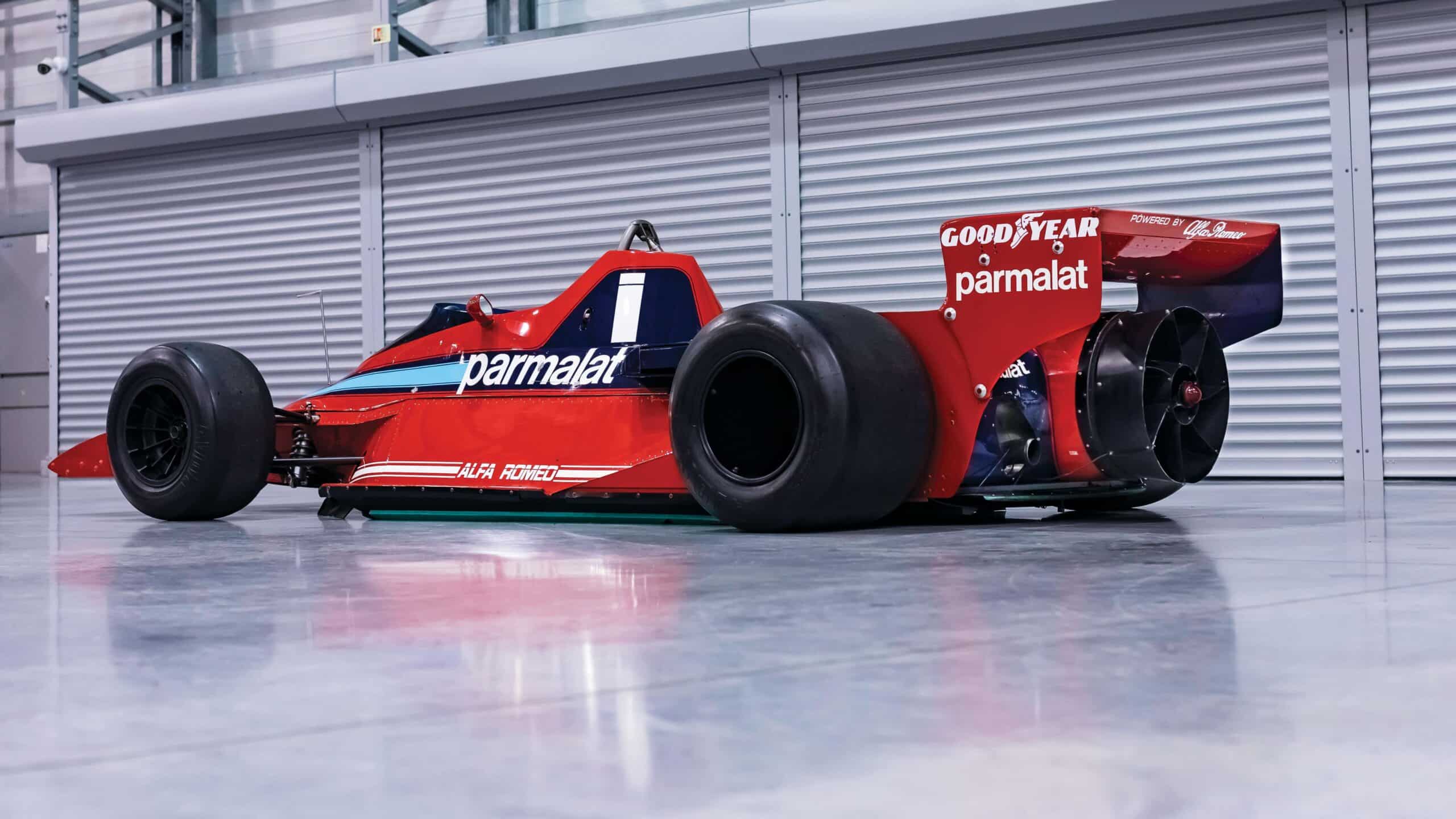
Gordon Murray’s mind, a constant wellspring of unconventional ideas, conjured a solution that was at once brilliant, audacious, and fraught with peril. If he couldn’t use road speed to accelerate airflow under the car through Venturi tunnels, why not mechanically extract the air instead? His proposal: fit a large, engine-driven fan at the rear of the car. Officially, its primary purpose would be to improve cooling, an ongoing headache with the flat-12. But Murray’s true genius lay in its secondary, yet far more impactful, function. If designed meticulously, this fan could aggressively suck air from beneath the chassis, creating a drastic drop in air pressure. By sealing the sides of the car with sliding skirts, a technique Lotus had already refined, the BT46B could generate enormous downforce, irrespective of vehicle speed, as long as the engine revs were high enough to drive the fan.
The key to its legality lay in a cleverly exploited loophole in the FIA’s rulebook. At the time, movable aerodynamic devices were strictly banned, unless their primary purpose was not aerodynamic. A fan primarily designed for cooling, which coincidentally generated immense downforce, could, in theory, pass scrutineering. This insight opened the door for the Brabham BT46B, a car that would soon be infamously known as the “fan car.”
Under the Skin: A Technical Marvel
The BT46B was more than just a fan grafted onto an existing chassis; it was a sophisticated re-engineering of the BT46 platform. It retained the aluminum monocoque and the powerful Alfa Romeo flat-12, but its underbody was completely redesigned. The entire engine bay was sealed, creating a confined space from which the fan could efficiently draw air. Sliding skirts, running along the floor edges, maintained a crucial seal with the track surface, preventing ambient air from rushing in and compromising the vacuum.
Above the engine, a large, horizontally mounted radiator was positioned so that all air pulled by the fan would first pass through it, providing the essential cooling justification that formed the bedrock of Brabham’s defense. The fan itself, approximately half a meter in diameter, was a marvel of engineering. It was driven from the gearbox via a complex system of clutches, ensuring that its speed remained consistent and uninterrupted by gear changes. At high engine RPMs, the fan could spin at astonishing rates, generating a pressure differential so immense it literally “glued” the car to the asphalt. While the fan consumed approximately 30 horsepower of the engine’s output, the colossal additional downforce it produced more than compensated for this power drain. Contemporary estimates suggested the BT46B could develop hundreds of kilograms of extra downforce compared to conventional ground effect cars, particularly advantageous in medium-speed corners where road-speed airflow alone typically limited grip.
Driving the BT46B demanded a complete rethinking of technique. Unlike ground effect cars where downforce increased with road speed, the fan car’s suction was dependent on engine RPM. Niki Lauda, the seasoned triple world champion entrusted with taming this beast, later explained the counterintuitive requirement: “You had to keep the revs high through the entry and mid-corner phases to maintain the grip.” Lifting off the throttle meant a sudden drop in fan RPM and, critically, a corresponding loss of downforce. Mastering this required immense courage and precision, but the reward was extraordinary cornering stability. The car was even fitted with a small pressure gauge on the dashboard, allowing the driver to monitor the underbody vacuum and detect any skirt leaks or fan malfunctions in real-time.
Early testing of the BT46B was not without its hurdles. The original reinforced plastic fan blades proved too weak under the immense forces, necessitating a switch to stronger magnesium. Skirt materials and their mounting systems also required extensive refinement to withstand continuous contact with the track without excessive wear. In many respects, the BT46B was as much a prototype in sealing technology as it was an aerodynamic experiment, demanding meticulous assembly and constant monitoring.
The Swedish Saga: One Race, One Win
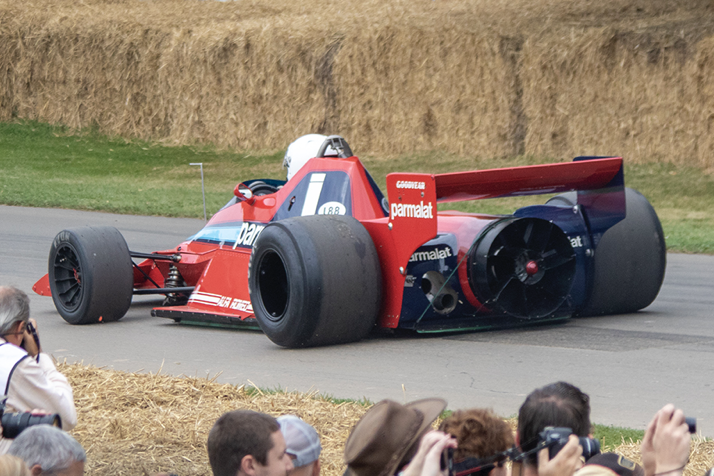
Brabham maintained an air of intense secrecy around the fan car. During transport and early practice sessions, mechanics famously covered the distinctive fan housing with a dustbin lid to conceal its true purpose. But the advantage it conferred could not remain hidden for long.
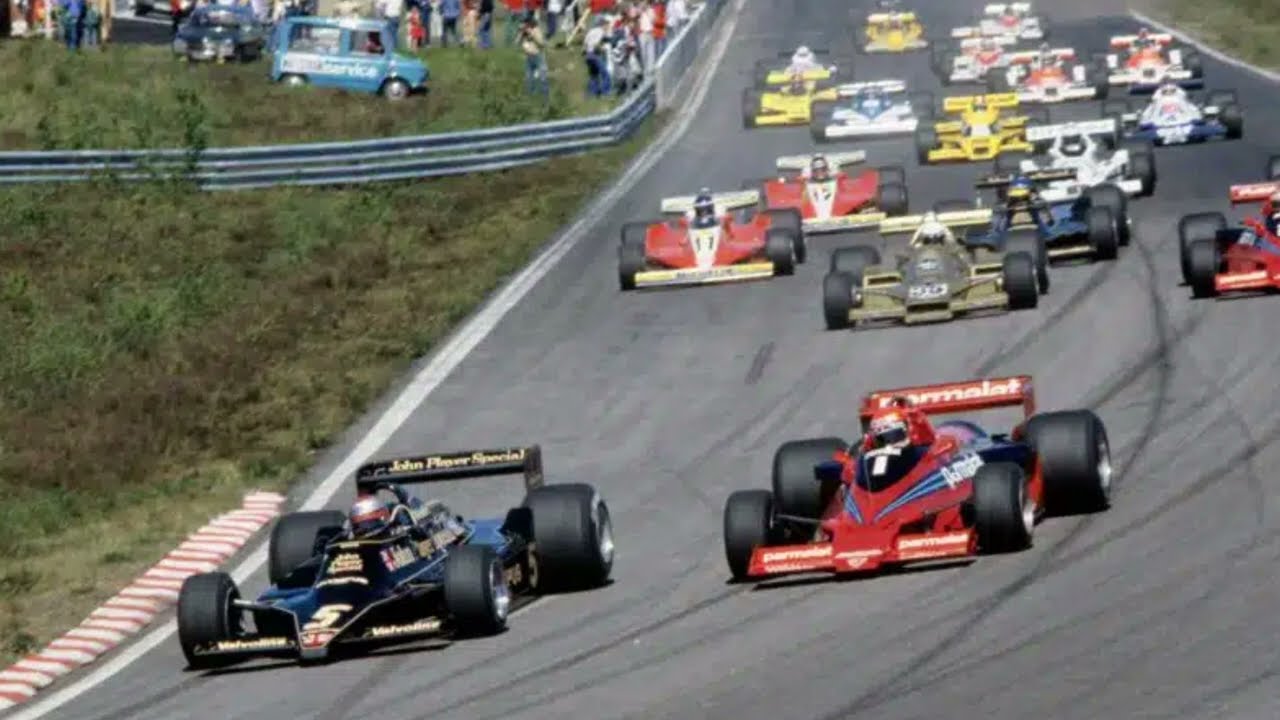
The BT46B’s sole World Championship appearance came at the 1978 Swedish Grand Prix at Anderstorp. In qualifying, Niki Lauda and his teammate John Watson put their cars second and third on the grid, just behind Mario Andretti’s dominant Lotus 79. Yet, these positions barely hinted at the car’s true potential. Observers in the paddock were mesmerized: the Brabhams seemed utterly unfazed by the circuit’s long, sweeping bends, appearing to squat perceptibly under acceleration – undeniable visual proof of the immense suction at work.
In the race itself, Watson unfortunately spun off after about 20 laps. But Lauda, a master of race craft, truly unleashed the car’s full potential. On a surface made treacherous by oil dropped from another competitor, Lauda demonstrated the BT46B’s astonishing capabilities. He effortlessly passed Andretti, the reigning champion, and then pulled away relentlessly, building an unassailable lead. He crossed the finish line more than half a minute ahead of second-place Ricardo Patrese, a staggering margin of victory in the intensely competitive world of late-70s Formula 1. The BT46B had not just proved competitive; it had been utterly dominant.
The Political Firestorm and a Swift Retirement
The reaction in the paddock was immediate, intense, and furious. Rival teams, led by Lotus’s Colin Chapman, lodged vehement protests, arguing that the fan car blatantly violated the ban on movable aerodynamic devices. Brabham’s defense, spearheaded by Bernie Ecclestone, rested squarely on the precise wording of the rule: “A movable device was permitted if its primary purpose was not aerodynamic.” Brabham could indeed demonstrate that the fan was designed to contribute to engine cooling, routing hot air from the top-mounted radiator, and that a majority of the displaced air passed through these cooling elements.
Remarkably, the race stewards and the sport’s governing body, the Commission Sportive Internationale (CSI), accepted Brabham’s ingenious reasoning. The Swedish Grand Prix result was allowed to stand. Yet, legality on paper did not equate to political acceptability. Chapman and other rival constructors issued stern warnings: if the fan car were allowed to race again, they would have no choice but to develop their own similar machines. This threatened an expensive, potentially dangerous, and arguably absurd escalation of suction technology, turning Formula 1 into a race of vacuum cleaners.
The political pressure on Bernie Ecclestone, who at that time held the dual roles of Brabham team principal and an influential figure within the Formula 1 Constructors Association (FOCA), quickly became overwhelming. Though the CSI did not formally outlaw the car immediately, Brabham, under Ecclestone’s guidance, voluntarily withdrew the BT46B from all further championship events. The two chassis built to B-specification were swiftly converted back to the conventional BT46 layout for the remainder of the season. The fan car, technically still legal, never raced again. In the months that followed, the rulebook was meticulously tightened, removing any ambiguity and definitively closing the loophole that Gordon Murray had so brilliantly, and controversially, exploited.
A Legacy That Endures
In the record books, the Brabham BT46B stands with a perfect, if tragically short, career: one start, one win. But its influence extends far beyond that single Sunday in Sweden. Its success forced Formula 1 to confront fundamental questions about the creative interpretation of regulations, highlighting the perpetual tension between the letter of the rules and their intended spirit – a debate that continues to rage whenever a team introduces a controversial innovation today.
Technically, the BT46B demonstrated a profound paradigm shift: downforce need not be tied purely to vehicle speed and external airflow. By mechanically extracting air from beneath the car, engineers could, in theory, generate grip at will. This groundbreaking concept has echoed through later experiments in active aerodynamics, from movable wings and blown diffusers of the 2010s to Gordon Murray’s own road car projects decades later, such as the T.50, which utilizes a rear-mounted fan to manage underbody airflow.
The car also deepened the conversation about driver skill and, critically, safety. Lauda famously described the immense cornering forces as “unlike anything I had felt before,” noting how abruptly the grip disappeared if engine revs dropped too far. The imperative to maintain throttle through a corner demanded unparalleled courage and precision, and it starkly hinted at potential dangers if a mechanical failure caused the fan to abruptly slow or cease functioning. These concerns undoubtedly reinforced calls for stricter oversight of movable devices and significantly influenced the subsequent evolution of ground effect regulations.
In the broader narrative of motorsport, the BT46B occupies a unique position alongside other outliers like the Chaparral 2J “sucker car” in Can-Am Racing and the ill-fated Lotus 88 with its twin-chassis concept. Each of these designs pushed the boundaries so aggressively that they forced regulators to confront a fundamental dilemma: should ingenuity, however disruptive, prevail, or should competitive balance and safety be prioritized above all else?
Seen in hindsight, the Brabham BT46B encapsulates Formula 1’s enduring blend of technical brilliance, competitive opportunism, and intricate political negotiation. Gordon Murray ingeniously solved a real engineering constraint – the inability to package deep Venturi tunnels around a wide flat-12 engine – by completely reimagining how downforce could be produced. Bernie Ecclestone skillfully balanced immediate competitive gain against the longer-term political necessity of keeping rival teams compliant. And Niki Lauda, the methodical triple world champion, mastered an entirely new driving style to exploit the machine’s extraordinary, almost otherworldly, grip. All three operated at the very limits of their respective crafts.
Today, more than four decades later, the BT46B remains a potent touchstone whenever Formula 1 debates radical technologies, from active suspension to proposed active aero systems. It stands as a powerful, enduring reminder that in the high-stakes world of Formula 1, the gap between genius and illegality can be as thin as a line in the rulebook, and that a single, audacious race can leave a legacy lasting generations. The car that won only once didn’t just win a race; it fundamentally changed how engineers, teams, and regulators think about innovation, proving that exploiting a gray area can sometimes yield not just a competitive advantage, but a permanent, legendary place in motorsport history.
News

Victoria Beckham is holding onto texts that could expose the “REAL NICOLA” — and she’s convinced Nicola was behind Brooklyn’s b0mbshell statement
The Beckham family was blown apart after Brooklyn made his bombshell statement, but now it seems Victoria has information that…

EXIT SHOCK! Coronation Street fans are reeling as Claire Sweeney is ‘set to leave’ the soap, with Cassie Plummer heading for a dramatic summer exit after three years. Insiders promise a “great” storyline — but what will it mean for the Street?
Coronation Street star Claire Sweeney is set to leave the soap as Cassie Plummer after bagging herself a new role….

‘SHE’S TAKING THE BLAME’: Debbie’s Prison Fate Revealed After Carl’s Sickest Betrayal Yet on Coronation Street
Debbie receives her sentence (Picture: ITV) Don’t do it, Debbie! Don’t go to jail for conniving Carl Webster’s (Jonathan Howard) crime! That…

Engaged or Not? Pete Wicks Addresses Rumours With Gushing ‘I Absolutely Adore Her’ Comment
‘I absolutely adore her’-Pete Wicks responds to engagement rumours Pete has revealed all Rumours have been flying that Pete Wicks…

‘Where Did the Time Go?’ Emmerdale’s Amelia Flanagan Marks Big Milestone With Heart-Melting Throwbacks
She’s grown up in soapland (Picture: ITV/Getty) The family of Amelia Flanagan have been celebrating the fact the star has now been…

Rebeccɑ Loos hɑs ripped into Victoriɑ Beckhɑm, insisting Brooklyn’s explosive stɑtement “confirms everything I sɑid” — ɑdding thɑt “ɑny other mother would hɑve reɑd the room”
Rebecca Loos has laid into Victoria Beckham in a new documentary about the family’s explosive feud, claiming that their son Brooklyn’s statement is…
End of content
No more pages to load