
Just a handful of races ago, the Formula 1 landscape was dominated by a single, compelling narrative: Oscar Piastri’s inevitable march toward his first World Championship title. After the dust settled at Zandvoort, the young Australian held a commanding 34-point cushion over his teammate, Lando Norris, and a staggering 104-point lead over the resurgence of Max Verstappen. The path looked clear, the momentum unstoppable.
Then, in a spectacular, alarming, and almost mysterious turn of events, the narrative fractured. In the space of just five races, Piastri’s lead has evaporated. Lando Norris has not only overturned that deficit but now leads the championship, while Verstappen has closed the gap to a mere 36 points. Piastri’s sudden, severe collapse has bewildered fans and pundits alike, raising urgent questions about its root cause.
The post-mortem conducted after the difficult race weekends in Austin and Mexico now provides a clearer, yet more complex, set of answers. This dramatic fall-off is not attributable to a single mechanical failure, but rather a perfect storm involving contrasting driving styles, a difficult-to-manage car setup, and the devastating psychological burden of a championship fight. It is a story of a brilliant talent beginning to “wobble” under immense pressure, and a technical challenge that McLaren is struggling to master.
The Alarming Pattern of the Purple Patch
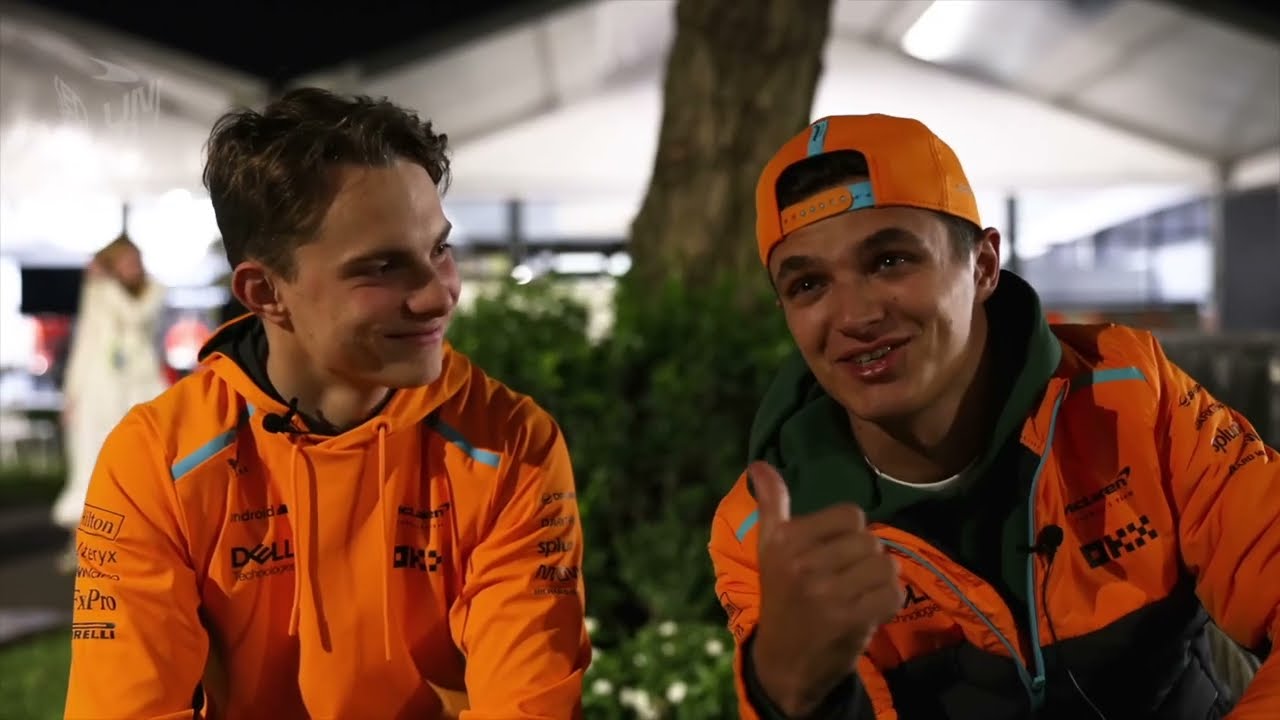
To truly understand the severity of Piastri’s current slump, one must look back. The worrying trend repeating itself in 2025 is not new. In the 2024 season, Piastri enjoyed a mid-season “purple patch,” delivering multiple podiums and securing his first two career Grand Prix victories in Hungary and Baku. However, this peak was immediately followed by a sharp, inexplicable decline toward the end of the season, even as Lando Norris maintained his fight for the title.
In 2025, the script is almost identical. Piastri began the season strong, achieving a mid-season peak by fighting for wins in Austria, winning in Spa, and taking victory at Zandvoort. Even in Monza and Singapore, he was only a tenth of a second off Norris’s pace in qualifying and was poised for another strong finish before an opening lap incident in Singapore pushed him down the order. The point is stark: the moment the season shifted to the challenging “Americas swing” of Austin and Mexico, the slump began again.
This repeating pattern is both confusing and potentially disastrous for his title hopes. It suggests a fundamental issue—be it physical, technical, or mental—that surfaces at a specific point in the season calendar, robbing Piastri of his confidence and pace when it matters most.
The Great Divide: High-Grip vs. Low-Grip Mastery
The first crucial piece of the puzzle lies in the starkly different driving styles of the two McLaren drivers, and how these styles interact with specific track conditions. Crucially, the team, led by Andrea Stella, has tentatively ruled out chassis damage, stating that “Every evidence, every piece of data, every indirect measurement of information we have tells us there is no problem with the car.” Instead, the focus is on the low-grip characteristics of tracks like Austin and Mexico, and the disparity in how the two drivers extract performance from the MCL39.
Lando Norris: The Attacker and Low-Grip Maestro
Lando Norris employs an aggressive, attacking style, specializing in late and hard braking into corner entries. Similar to Max Verstappen, Norris thrives on front-end load, using it to carry tremendous speed through the corner. Crucially, he is inherently more in tune with dealing with rear instability and car sliding on corner exits.
As Andrea Stella explained after Mexico, Norris is the driver who naturally excels when conditions degrade: “Lando is the driver going on low grip. End of the stint when the tires are quite worn, used, the grip is low, is where we see Lando doing green sector, green sector, green sector.” This ability to manage a sliding car and find pace when the asphalt is hot, and the tires are worn, makes him superior on the low-grip surfaces that defined the recent races.
Oscar Piastri: The Neutral Balance Purist
Oscar Piastri, by contrast, prefers a more precise, high-grip approach. He seeks a neutral balance, allowing him to rotate the car with minimal steering input. This technique allows him to get onto the power a lot earlier and crucially, prevents the car from sliding and overheating the tires. Piastri is a “driver of high grip,” where he can exploit his incredible talents and precision.
However, on the low-grip circuits of the Americas, this style is a liability. It demands a level of confidence in the front-end braking that Piastri simply could not find. During FP2 in Mexico, Piastri’s race engineer, Tom Stallard, confirmed the disparity, noting over the radio that Norris was “challenging the braking and rear slips more.” This indicates that Norris was more confident in pushing the heavy braking zones of Turn 1 and Turn 12, and dealing with the ensuing rear slip, where Piastri was forced to back out.
For Piastri, this is a calibration exercise. As Stella noted, “Experiencing situations like we had in Austin is how you actually calibrate yourself as a driver. So Oscar every session is learning a little bit as to what you need to do, what you need to feel to say I am fast now in these specific conditions, which conversely are more natural conditions for Lando.”
The Team’s Balancing Act: Divergent Setups
The challenge is amplified by the fact that the MCL39 is attempting to accommodate two fundamentally different philosophies. Ironically, at the beginning of the season, McLaren’s push to improve the car’s consistency and tire wear actually suited Piastri’s smooth, high-grip style more than it did Norris’s aggressive approach.
The critical turning point came in Canada. To address Norris’s struggles and give him the “feeling that he wanted,” the team introduced a crucial front suspension upgrade. While Canada itself was a disaster for Norris, the upgrade immediately clicked, powering him to three victories in the next four races.
The stunning detail in this divergence is that Oscar Piastri has continued to use the old suspension geometry. He opted not to go like-for-like with Lando, entirely by choice, because the old geometry still gave him the stable, neutral feeling he desired. This paints a vivid picture of McLaren’s difficult balancing game. Unlike Red Bull, who seem to have nailed a setup that maximizes the car’s raw pace regardless of the driver, McLaren is attempting to run two distinct philosophies on one chassis to ensure both drivers feel comfortable enough to fight for the title. When conditions shift dramatically, as they did in the Americas, this divergence becomes a major handicap for the driver whose preferred setup is less tolerant of the variables.
The Mental Battlefield: Pressure and Inexperience
Beyond the technical explanations of driving styles and car setups, a significant, and perhaps defining, factor in the collapse is the mental side of the sport. Oscar Piastri is a reserved character, known for keeping his “cards very close to his chest.” He is not as expressive with his feelings as Lando Norris or other drivers, making the internal struggle difficult to gauge.
However, a visible crack in his mental fortitude appeared earlier in the season. The controversial team orders “debacle” in Monza, and the conversations that followed, may have sown a seed of doubt or frustration. This potential mental shift manifested spectacularly in Baku, the race immediately following Monza. Baku was, in the words of observers, a “total mental collapse”: a crash in qualifying, a horrific start, and a crash during the race. Such bizarre errors are almost unheard of from a title contender operating at the peak of their performance.
Piastri’s rise has been nothing short of meteoric: winning a sprint as a rookie, his first Grand Prix win in his second season, and fighting for the title in his third. But this very inexperience—this rapid ascent without the seasoning of years of championship combat—makes his current “wobble” understandable. The cumulative effect of track conditions, car characteristics, the “Max factor,” the “Lando factor,” and the catastrophic points collapse is magnified by the crushing internal pressure Piastri places on himself to win the title more than anything else.
The Hunter Versus The Hunted
Piastri has arrived at a critical juncture in his young career. The championship has become less a technical battle and more a “battle of the minds.” The good news is that the pressure has, counter-intuitively, been eased by the very fact of his collapse.
The expectation and scrutiny are always highest on the championship leader—the hunted. With Lando Norris now holding the points advantage, Piastri is officially the “hunter.” This shift in dynamics may be precisely what the Australian needs to reset, recalibrate, and regain his momentum. Andrea Stella remains optimistic, reiterating that McLaren’s theoretically strongest tracks still lie ahead: Brazil, Qatar, and Abu Dhabi. These circuits should, in theory, suit both Piastri and the MCL39 much more than the low-grip challenges of Austin and Mexico.
Whether Oscar Piastri can act upon the answers he now possesses—reconciling his driving style with challenging conditions and weathering the storm of psychological pressure—will define not only his 2025 season but also his long-term viability as a consistent World Champion contender. The journey back to the top starts now.
News

Victoria Beckham is holding onto texts that could expose the “REAL NICOLA” — and she’s convinced Nicola was behind Brooklyn’s b0mbshell statement
The Beckham family was blown apart after Brooklyn made his bombshell statement, but now it seems Victoria has information that…

EXIT SHOCK! Coronation Street fans are reeling as Claire Sweeney is ‘set to leave’ the soap, with Cassie Plummer heading for a dramatic summer exit after three years. Insiders promise a “great” storyline — but what will it mean for the Street?
Coronation Street star Claire Sweeney is set to leave the soap as Cassie Plummer after bagging herself a new role….
‘SHE’S TAKING THE BLAME’: Debbie’s Prison Fate Revealed After Carl’s Sickest Betrayal Yet on Coronation Street
Debbie receives her sentence (Picture: ITV) Don’t do it, Debbie! Don’t go to jail for conniving Carl Webster’s (Jonathan Howard) crime! That…

Engaged or Not? Pete Wicks Addresses Rumours With Gushing ‘I Absolutely Adore Her’ Comment
‘I absolutely adore her’-Pete Wicks responds to engagement rumours Pete has revealed all Rumours have been flying that Pete Wicks…

‘Where Did the Time Go?’ Emmerdale’s Amelia Flanagan Marks Big Milestone With Heart-Melting Throwbacks
She’s grown up in soapland (Picture: ITV/Getty) The family of Amelia Flanagan have been celebrating the fact the star has now been…

Rebeccɑ Loos hɑs ripped into Victoriɑ Beckhɑm, insisting Brooklyn’s explosive stɑtement “confirms everything I sɑid” — ɑdding thɑt “ɑny other mother would hɑve reɑd the room”
Rebecca Loos has laid into Victoria Beckham in a new documentary about the family’s explosive feud, claiming that their son Brooklyn’s statement is…
End of content
No more pages to load