
The roar of the engines and the blinding floodlights of the Singapore Grand Prix usually provide a backdrop for thrilling external battles, but this year, the most explosive drama unfolded within the confines of a single garage. McLaren, a team basking in the glory of securing their second consecutive Constructors’ World Championship, found their celebrations severely overshadowed by an on-track collision between their two title-contending star drivers, Lando Norris and Oscar Piastri. The fiery, wheel-to-wheel contact on the opening lap of the race was more than just a racing incident; according to top pundits, it was a pivotal, line-in-the-sand moment that has irrevocably “changed the ground rules” for the remainder of the Formula 1 season.
The incident, which saw Norris aggressively pass his teammate, Piastri, resulting in contact that sent the Australian momentarily wide and dropping him a place, has unearthed a simmering tension and exposed a potential fracture in the carefully curated ‘let them race’ philosophy at Woking. For Piastri, who had started an impressive third, the move was a direct challenge to the internal harmony of the team, and his furious, uncensored radio messages instantly went viral, offering a rare, raw glimpse into the high-stakes emotional cauldron of an F1 championship fight.
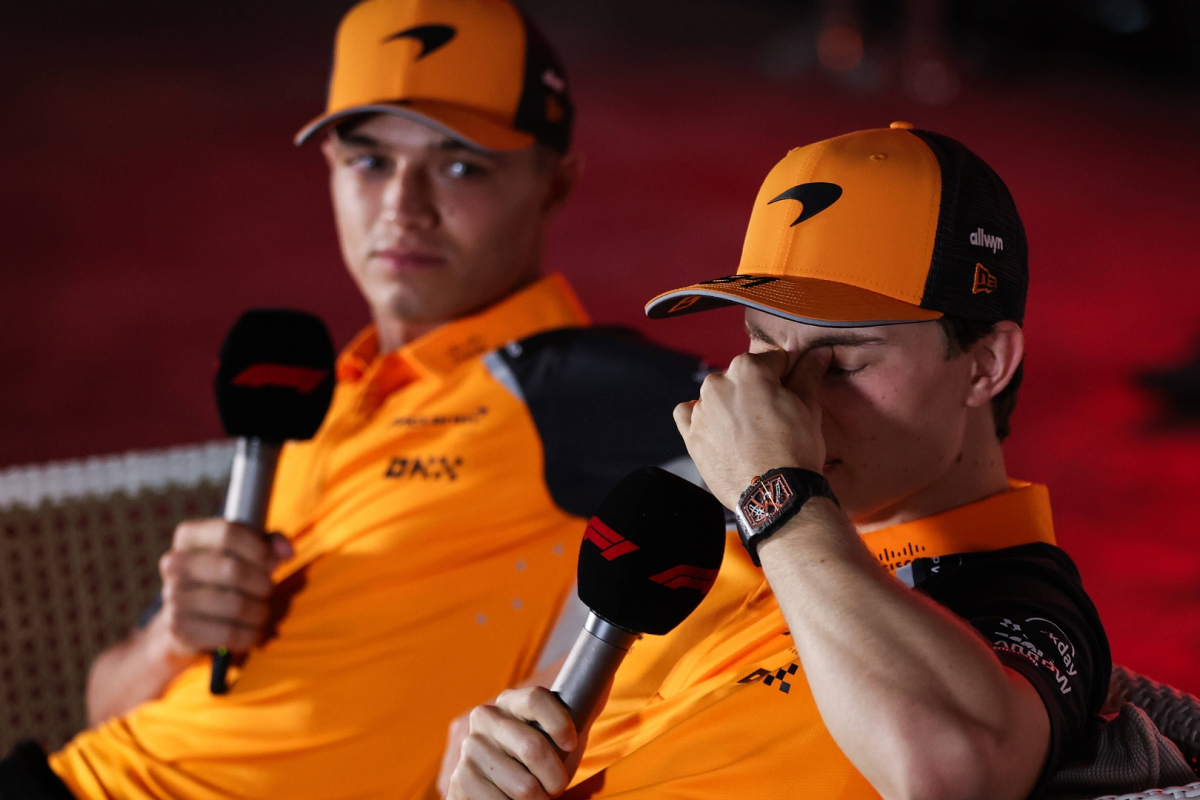
The Lap One Betrayal: ‘That’s Not Fair’
The Marina Bay Street Circuit is notorious for its unforgiving nature, and the first few corners often dictate the outcome of the entire race. Starting fifth, Norris got a strong getaway, and as the field funneled into the tight Turn 3, the stage was set for the drama. Norris, avoiding a concertina effect with the cars ahead, darted to the inside of Piastri. A moment of correction saw his car slide, clipping the rear of Max Verstappen’s Red Bull before making forceful contact with the side of Piastri’s McLaren.
It was a classic, aggressive racing maneuver, opportunistic and punchy, as later described by Sky Sports F1 legend Martin Brundle. However, for Piastri, the consequence was immediate: a loss of position, a jarring moment that could have easily ended his race in the barriers, and a sense of profound injustice. His immediate reaction, broadcast worldwide, was a desperate plea to his engineer, Tom Stallard.
“So are we cool about Lando just barging me out of the way or… what’s the go there?” Piastri asked, his voice strained with disbelief. The team’s subsequent reply sealed the shift in dynamics. Stallard informed him that the team had reviewed the incident, attributing Norris’s action to avoiding a car ahead, and would “take no action during the race.”
Piastri’s response was the most telling, stripping away the usual PR veneer that often masks internal F1 conflicts: “Mate, that’s not fair, that’s not fair. If he has to avoid another car by crashing into his teammate, then that’s a pretty s*** job of avoiding.”
The young Australian’s frustration was palpable and entirely understandable. This was not a minor kerfuffle. This was his teammate, his direct rival for the most prestigious prize in motorsport, using a controversial, heavy-handed tactic to gain a crucial advantage—an advantage the team then validated. In that moment, the unwritten code of conduct, the “Papaya rules” that had supposedly governed their respectful rivalry, were incinerated. The championship gap between the two was subsequently cut to a mere 22 points, intensifying the stakes of the final few races dramatically.

The ‘Let Them Race’ Justification vs. Internal Consistency
McLaren’s leadership, facing a media firestorm, was quick to defend their decision, leaning heavily on the “let them race” ethos that has been a hallmark of their operation. Both CEO Zak Brown and Team Principal Andrea Stella were unrepentant.
Brown described the incident as simply “hard” and “tough” racing, adding that he viewed it as “clean.” He reiterated the team’s commitment to allowing their drivers to compete: “You can’t win the Constructors’ without two awesome racing drivers. As you can see, we’re letting them race. They race hard, they race clean, they race to win.”
Stella echoed this sentiment, urging “perspective” on Piastri’s passionate radio comments. “It’s a comment from a driver in an F1 car, there’s the heat of the moment,” he stated. However, this unwavering commitment to the “let them race” principle now faces the glaring issue of consistency and perception.
Just two races prior, at the Italian Grand Prix in Monza, a strategic foul-up led to Norris losing a position to Piastri during a slow pit stop. On that occasion, McLaren management intervened, ordering Piastri to relinquish the position back to Norris to maintain the pre-stop status quo. The difference in reaction is stark. In Monza, a mechanical issue led to a team order to correct the position. In Singapore, a deliberate, aggressive, and controversial on-track move by one driver on his teammate was deemed a “racing incident” requiring no remedial action.
This perceived double standard—intervening when it benefits one driver (Norris, at Monza) but refusing to intervene when the other (Piastri, in Singapore) is disadvantaged by an aggressive move—is what has fuelled accusations of Norris enjoying a form of “favouritism” or at least a stronger internal position within the team hierarchy.
The Brundle Verdict: A Permanent Reset
The most significant analysis came from Martin Brundle, whose commentary during the race offered a chilling prognosis for the remainder of the season. Watching the replay, Brundle immediately sensed the magnitude of the moment.
“I thought it was punchy, opportunistic, aggressive, but this is a motor race,” Brundle commented live. He then delivered the verdict that has become the defining headline of the event: “I think the ground rules between the two McLarens have just changed for the rest of the season.”
This is the central, dramatic fallout. By not forcing Norris to hand the place back, McLaren has effectively signaled to both drivers that a new, more aggressive benchmark for on-track conduct has been established. The softer, more respectful rivalry of the earlier season is now over.
For Piastri, this is not just about a single race result; it’s a realization that he can no longer rely on a reciprocal, team-friendly racing agreement. As Brundle himself noted, “Oscar will say, ‘ok, then, that’s it. That’s how we’re going racing.’” The subtext is clear: Piastri now feels he has full license to drive with the same ruthless aggression against his teammate, a dynamic that guarantees more sparks will fly.
The immediate impact was evident in the race strategy that followed. When asked later if he would be happy for Piastri to pit first to protect him from the approaching threat of Charles Leclerc, Norris reportedly gave a clear “no,” seizing the strategic advantage his earlier move had created.

The Long-Term Fallout
While the Constructors’ Championship is secure, the Drivers’ Championship is now a viper’s nest of tension. Piastri, typically calm and measured, was visibly dismissive and terse when questioned about the incident post-race, clearly still fuming beneath the surface. He stated he would need to review the replays, but stressed that “the two cars coming together is never what we want.”
The McLaren management’s job just got infinitely harder. They must now manage a rivalry where the “ground rules” have indeed been reset to a state of internal warfare, where every future wheel-to-wheel battle will be scrutinized under the lens of the Singapore precedent. The internal “good conversations” promised by Andrea Stella will be anything but.
The explosive Singapore clash between Lando Norris and Oscar Piastri did more than just swap two positions on track; it has redefined the nature of their championship fight. It has replaced internal respect with a new, aggressive ruthlessness, signaling a dramatic power shift that threatens to destabilize one of F1’s most successful teams. For the fans, this is captivating drama; for McLaren, it is a ticking time bomb as the season heads towards its electrifying, and now brutally competitive, conclusion. The “Papaya Rules” have been rewritten in aggressive orange on the unforgiving street circuit, ensuring that the final races will be mandatory viewing.
News

Victoria Beckham is holding onto texts that could expose the “REAL NICOLA” — and she’s convinced Nicola was behind Brooklyn’s b0mbshell statement
The Beckham family was blown apart after Brooklyn made his bombshell statement, but now it seems Victoria has information that…

EXIT SHOCK! Coronation Street fans are reeling as Claire Sweeney is ‘set to leave’ the soap, with Cassie Plummer heading for a dramatic summer exit after three years. Insiders promise a “great” storyline — but what will it mean for the Street?
Coronation Street star Claire Sweeney is set to leave the soap as Cassie Plummer after bagging herself a new role….

‘SHE’S TAKING THE BLAME’: Debbie’s Prison Fate Revealed After Carl’s Sickest Betrayal Yet on Coronation Street
Debbie receives her sentence (Picture: ITV) Don’t do it, Debbie! Don’t go to jail for conniving Carl Webster’s (Jonathan Howard) crime! That…

Engaged or Not? Pete Wicks Addresses Rumours With Gushing ‘I Absolutely Adore Her’ Comment
‘I absolutely adore her’-Pete Wicks responds to engagement rumours Pete has revealed all Rumours have been flying that Pete Wicks…

‘Where Did the Time Go?’ Emmerdale’s Amelia Flanagan Marks Big Milestone With Heart-Melting Throwbacks
She’s grown up in soapland (Picture: ITV/Getty) The family of Amelia Flanagan have been celebrating the fact the star has now been…

Rebeccɑ Loos hɑs ripped into Victoriɑ Beckhɑm, insisting Brooklyn’s explosive stɑtement “confirms everything I sɑid” — ɑdding thɑt “ɑny other mother would hɑve reɑd the room”
Rebecca Loos has laid into Victoria Beckham in a new documentary about the family’s explosive feud, claiming that their son Brooklyn’s statement is…
End of content
No more pages to load