
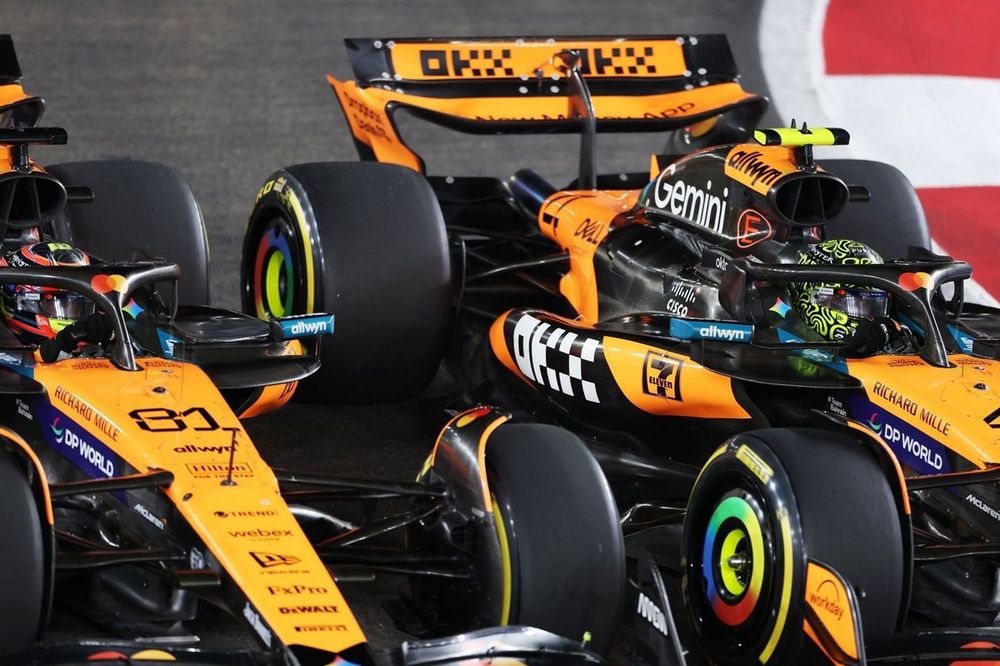
The Singapore Grand Prix delivered all the drama and unexpected turns one expects from the Marina Bay street circuit, but the most significant explosion of the weekend didn’t happen under the floodlights—it happened within the confines of the McLaren garage. When Lando Norris executed a daring, wheel-banging pass on his championship-leading teammate, Oscar Piastri, on the opening lap, it wasn’t just a move for track position; it was the final, devastating puncture to McLaren’s painstakingly constructed, yet fundamentally flawed, policy of “guaranteed fairness.”
The immediate fallout has plunged the Woking team into a crisis of conscience and management. This was not a minor incident; it was a watershed moment that has transformed a laudable internal policy into a genuine political and emotional catastrophe. Piastri’s palpable anger—an almost unprecedented display from the typically unflappable driver—coupled with the team’s decision to essentially let Norris off the hook, has created a schism that threatens to derail their double-championship aspirations, or at the very least, ensure their ultimate winner is crowned amid a toxic cloud of distrust.

The Lap One Catastrophe and the Vicious Cycle of Interpretation
The incident itself, while appearing to be a classic first-lap tussle, was immediately complicated. As Norris drove aggressively into Turn 3 to get past Piastri, he made contact—not initially with his teammate, but with Max Verstappen. Norris then bounced off Verstappen’s car and subsequently hit Piastri. Norris’s defense was immediate and consistent: the contact with Piastri was a consequence of having to avoid Verstappen, an unintentional byproduct of legitimate racing. He argued that it was “clumsy and not deliberate,” and that he wasn’t being aggressive toward his teammate directly.
The stewards, often lenient on opening-lap incidents and doubly so when involving teammates, ultimately took no action. But the controversy lies not with the FIA, but with McLaren itself. Despite Piastri’s clearly communicated fury—captured vividly over the team radio and through his restrained but rigid post-race body language—McLaren’s leadership also decided to stand down.
This inaction, however, is a direct contradiction of the team’s own rules, or at least, Piastri’s interpretation of them. Team Principal Andrea Stella is on record previously stating that McLaren drivers “simply aren’t allowed to make contact.” Norris, by his own admission, failed in the most fundamental rule of racing—avoiding collision with his teammate—and the contact was definitively race-changing. Norris himself conceded that had he not made those places on lap one, he likely never would have, underscoring the decisive, race-defining nature of the contact.
The team’s justification—that Verstappen’s presence was a mitigating factor—is valid on the surface but collapses under close scrutiny. If Verstappen is a mitigating factor for Norris running into Piastri, then one must acknowledge that the Verstappen touch only occurred because Norris was aggressively trying to overtake Piastri. Norris was entitled to go for the move; no one can begrudge him that competitive spirit, especially in the thick of a title battle. However, with that entitlement comes a non-negotiable responsibility: thou shalt not hit thy teammate. He failed that test, yet the team refused to apply the consequence.
The Monza Ghost Haunts the Garage
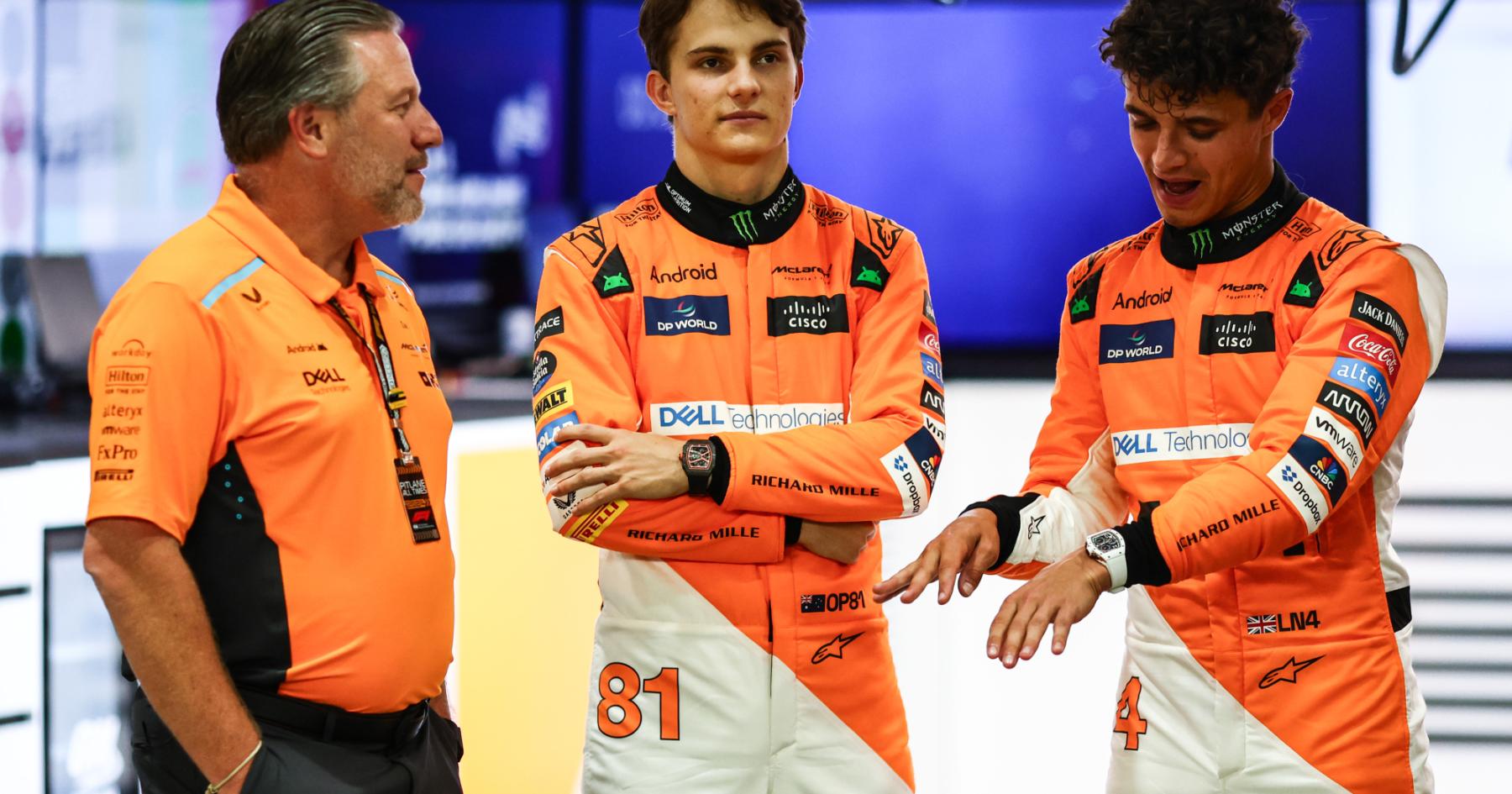
To understand the depth of Piastri’s frustration, one must rewind two races to the Italian Grand Prix in Monza. That weekend, a slow pit stop compromised Norris’s race. In a clear act of team intervention, Piastri was ordered to let his teammate by to rectify the time loss. Piastri complied, adhering to the team’s call for “fairness” and the greater good of the championship fight.
For Piastri and his camp, the two events are now irrevocably linked, forming a pattern of perceived injustice. At Monza, the team pulled the “levers of justice” to compensate Norris for a team blunder (the slow pit stop) at Piastri’s expense. In Singapore, when Piastri was the aggrieved party, bounced out of the way by a clumsy, aggressive move from his teammate, those levers of justice were suddenly frozen.
Piastri’s in-race anger, an unusually sharp display for the cool-headed Australian, was justified precisely because he saw the double standard play out in real time. He felt Norris “did a short job avoiding Verstappen if it meant hitting his teammate instead.” He adhered to the team’s spirit of fairness, even when it hurt him, yet when he needed protection, the team essentially shrugged.
This asymmetry of intervention—correcting an internal error when it benefits the more established driver (Norris) but calling off intervention when it would punish him—sends an unmistakable and devastating message to the junior driver: The commitment to fairness is conditional.
The Breakdown of Trust: The Real Cost of Inaction
The true currency in a championship fight between teammates is not points, but trust. As John Noble reported from the Singapore paddock, this is the element McLaren’s leadership is most desperate to retain. Andrea Stella emphasized that they would review the incident in “forensic detail” because “there is a lot at stake,” underscoring that the central issue is not just points, but the integrity of the relationship between the drivers.
Yet, Piastri’s prickly radio messages, including a notably forced congratulation to the team for building the car “strong” during post-race pleasantries, conveyed his true feelings: frustration, simmering resentment, and perhaps, a sense of betrayal. The team has successfully maintained the trust of both drivers until now, ensuring that both are treated equally and that the best driver wins, not one handed a position. That principle is now in severe jeopardy.
The team’s decision to let the Singapore incident go immediately, rather than waiting for a forensic review, will be seen by Piastri as a judgment passed. It signals to him that a clumsy, aggressive move that benefits Norris is deemed “just racing,” whereas a team blunder that disadvantages Norris demands an immediate order to concede position.
This perceived imbalance empowers Piastri to take radical action in the final races. The consequence of McLaren’s over-management and over-promising on fairness is the creation of a driver who now feels justified in playing hardball. Piastri could, and just might, ignore any future McLaren request in the name of fairness. If he is asked to concede track position or manage his pace for the good of the team, he can now justifiably turn the tables and say, “I moved aside for Lando at Monza, but you’ve not corrected his blunder here.”
A New Era of Papaya Anarchy
With the constructors’ title now officially wrapped up, the stakes have shifted entirely. The team’s collective goal has been achieved. What remains is the private war for the driver’s crown, a purely individual pursuit. The dynamic has irrevocably changed from two talented teammates pushing each other within a framework of amicable competition to a much darker, politically charged battle.
By choosing to intervene at Monza and choosing not to intervene in Singapore, McLaren has created a monster of its own making: a driver (Piastri) who has seen the team’s conditional loyalty firsthand and a driver (Norris) who has been implicitly told that aggressive first-lap moves on his teammate, if wrapped in the mitigating blanket of avoiding an external rival, are permissible.
This encourages Piastri to do exactly the same back to Norris in the future. The tacit understanding that there are “Papaya Rules”—an unspoken agreement to preserve the cars and the relationship—has been violated by one driver and excused by the team.
The final races of the season will now be defined by this fractured trust. It is no longer a question of whether Norris or Piastri is the faster driver on any given Sunday, but a question of how much obligation either driver feels toward the other and the team. Given the monumental nature of the Singapore incident—an internal explosion that boiled the cool-headed Piastri—the answer is terrifyingly simple: None.
The championship fight is now truly “every McLaren man for himself.” McLaren’s laudable goal of fairness has been shown to be a brittle facade, shattering under the pressure of a title fight. The mess is palpable, the tension is real, and the consequences of their inaction may haunt them long after the season finale.
News

Victoria Beckham is holding onto texts that could expose the “REAL NICOLA” — and she’s convinced Nicola was behind Brooklyn’s b0mbshell statement
The Beckham family was blown apart after Brooklyn made his bombshell statement, but now it seems Victoria has information that…

EXIT SHOCK! Coronation Street fans are reeling as Claire Sweeney is ‘set to leave’ the soap, with Cassie Plummer heading for a dramatic summer exit after three years. Insiders promise a “great” storyline — but what will it mean for the Street?
Coronation Street star Claire Sweeney is set to leave the soap as Cassie Plummer after bagging herself a new role….

‘SHE’S TAKING THE BLAME’: Debbie’s Prison Fate Revealed After Carl’s Sickest Betrayal Yet on Coronation Street
Debbie receives her sentence (Picture: ITV) Don’t do it, Debbie! Don’t go to jail for conniving Carl Webster’s (Jonathan Howard) crime! That…

Engaged or Not? Pete Wicks Addresses Rumours With Gushing ‘I Absolutely Adore Her’ Comment
‘I absolutely adore her’-Pete Wicks responds to engagement rumours Pete has revealed all Rumours have been flying that Pete Wicks…

‘Where Did the Time Go?’ Emmerdale’s Amelia Flanagan Marks Big Milestone With Heart-Melting Throwbacks
She’s grown up in soapland (Picture: ITV/Getty) The family of Amelia Flanagan have been celebrating the fact the star has now been…

Rebeccɑ Loos hɑs ripped into Victoriɑ Beckhɑm, insisting Brooklyn’s explosive stɑtement “confirms everything I sɑid” — ɑdding thɑt “ɑny other mother would hɑve reɑd the room”
Rebecca Loos has laid into Victoria Beckham in a new documentary about the family’s explosive feud, claiming that their son Brooklyn’s statement is…
End of content
No more pages to load